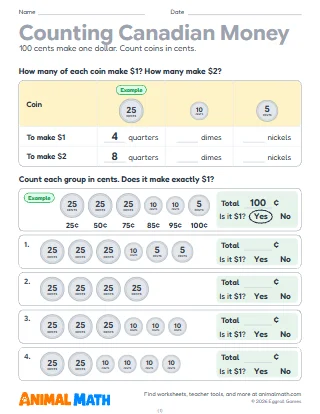
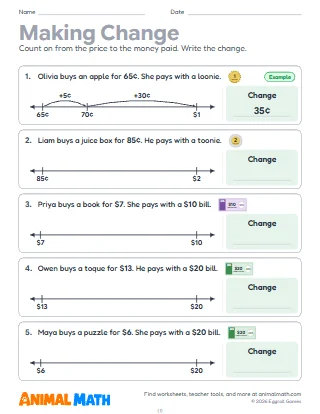
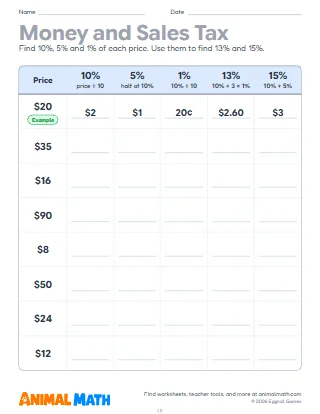
Five pages on knowing Canadian coins and bills and what each is worth, for Kindergarten and Grade 1. On page 1 children draw a line from each of the five coins to its name, then write what a loonie, a quarter, a $5 bill and a $10 bill are worth. Page 2 shows eight pieces of money: children circle coin or bill and write each value, then circle the one worth more in four pairs. Every bill is the same size, so the number on it tells its worth. Page 3 shows pairs of coins at their real sizes; children circle the coin worth more, including the dime, which is smaller than the nickel but worth more, then number four coins from least to greatest value. Page 4 counts rows of nickels in 5s, dimes in 10s and toonies in 2s, writing the count under each coin and then the total. Page 5 asks how many nickels make a dime, how many loonies make a toonie and so on, then shows price tags with three groups of coins each: children circle the group that pays the exact price. The coins and bills are our own drawings, in the real shapes, colours and sizes, with the value written on each as on the real ones.
Pass round real or play coins before page 1 and say their names together: nickel, dime, quarter, loonie, toonie. Ask which coin is worth the most and which is worth the least. Many children say the nickel is worth more than the dime because it is bigger, which makes page 3 a good talk. For page 4, count a row out loud together, tapping each coin: 5, 10, 15, 20. Play coins make page 5 easy to check: swap two nickels for a dime, or two loonies for a toonie.
Empty a wallet or a piggy bank and sort the coins. Name each one, count the dimes in 10s and the nickels in 5s, and ask which coin is worth the most. Play store with price labels under $1 on a few toys, and pay with the exact coins.
This pack supports the following Common Core State Standards for Mathematics:
© Copyright 2010. National Governors Association Center for Best Practices and Council of Chief State School Officers. All rights reserved.
The five Canadian coins and the $5 to $50 bills, and what each one is worth. Students name the nickel, dime, quarter, loonie and toonie, tell coins from bills, find the coin worth more, count coins in 2s, 5s and 10s, and pay an exact price.
Tell us what to make next, or build your own with a worksheet maker.
This worksheet is free to download, print, copy, and hand out in your classroom or at home. You do not need to create an account, and there are no watermarks on the PDF.