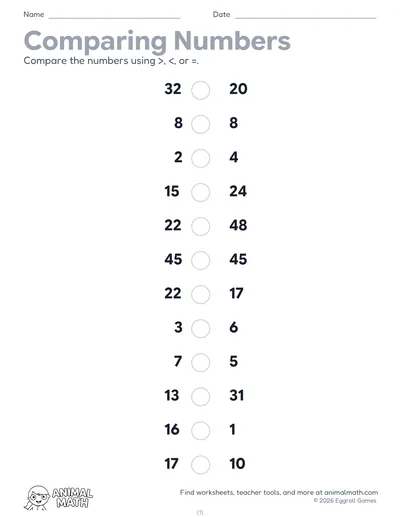
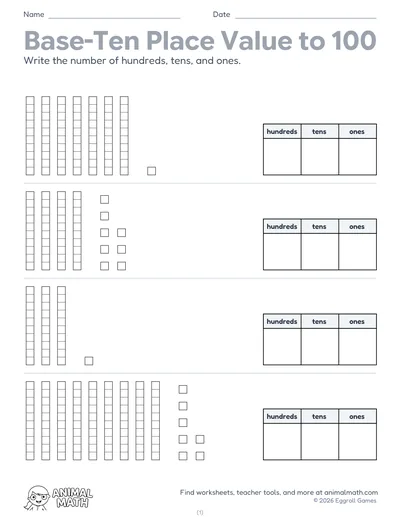
Five pages on comparing and ordering two-digit numbers, built on tens and ones. On page 1 students write the number each base-ten picture shows and write >, < or = between them; one pair is 2 tens 13 ones and 3 tens 3 ones, which are equal. Page 2 turns it around: the numbers are given, students draw a stick for each ten and a circle for each one, then compare. On page 3 students write the numbers of three base-ten pictures and put them in order. The signs between the answer blanks say which way: < means least to greatest and > means greatest to least. Page 4 orders three numbers on cards, including numbers past 100, such as 98, 105 and 112. On page 5 students draw a line from each number to its place on a number line (20 to 40, 0 to 100 by tens, and more). Each page starts with a worked example.
Build two numbers with base-ten blocks, like 52 and 25, and ask which is greater and how the blocks show it: compare the tens first, and only look at the ones when the tens are the same. Put three number cards on the board and have three students hold them and stand in order. For page 5, use a masking tape number line on the floor and let students walk to 33 or 68.
Write two numbers from a house number, a price or a page number and ask which is greater and why. Pick three page numbers in a book and put them in order, then find each page: the book is a number line.
This pack supports the following Common Core State Standards for Mathematics:
© Copyright 2010. National Governors Association Center for Best Practices and Council of Chief State School Officers. All rights reserved.
A 5-page pack for 1st grade on comparing and ordering two-digit numbers with tens and ones. Write the numbers shown by two base-ten pictures and compare them with >, < or =. Draw a stick for each ten and a circle for each one to compare two numbers. Write the numbers of three base-ten pictures and put them in order, then order three numbers up to 120 from least to greatest and from greatest to least. Finish by drawing a line from each number to its place on a number line. Every page comes in color and in black and white. Answer keys included.
Tell us what to make next, or build your own with a worksheet maker.
This worksheet is free to download, print, copy, and hand out in your classroom or at home. You do not need to create an account, and there are no watermarks on the PDF.