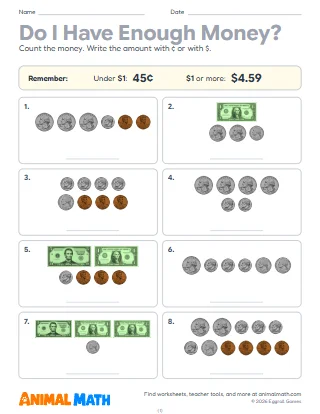
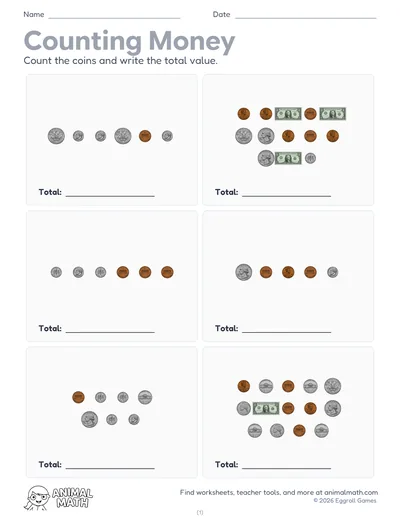
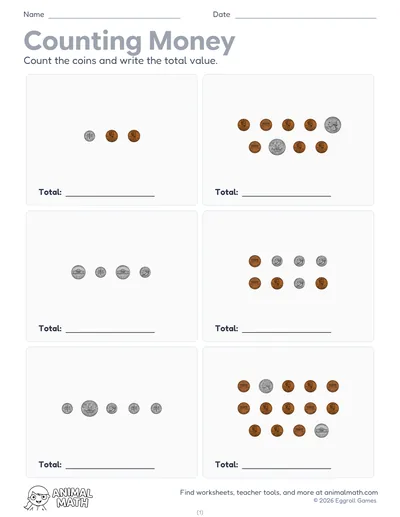
Five pages about finding the value of a collection of bills and coins. Page 1 has eight collections of bills only, so students count $20s, $10s, $5s and $1s and write whole dollars. Page 2 adds quarters, dimes, nickels and pennies: six collections laid out biggest first, each written as dollars and cents. Page 3 shows the counting itself: students write the total so far under each bill and coin ($20, $30, $35, $35.25 ...) and then the total, with a worked example at the top. On page 4 the money is in mixed order: students find both totals in each pair and write >, < or = between them. Page 5 mixes it up: circle the collection that shows a price, then solve four word problems about bills and coins.
Before page 1, hand out play bills and have partners sort them into piles by value, then count the biggest pile first. Model page 3 out loud: "twenty, thirty, thirty-five, thirty-five twenty-five" as you point to each piece. On page 4, students can sort the mixed money with arrows or numbers before counting it.
Empty a wallet or a coin jar on the table and count it together, biggest bill first. Take turns: one person makes an amount like $23.40 with play money or real coins, and the other counts it to check.
This pack supports the following Common Core State Standards for Mathematics:
© Copyright 2010. National Governors Association Center for Best Practices and Council of Chief State School Officers. All rights reserved.
A 5-page money pack for 3rd grade. Count collections of $1, $5, $10, $20 and $50 bills, then bills with quarters, dimes, nickels and pennies, and write each amount as dollars and cents, like $45.85. Count on from the biggest bill and write the total so far under each piece, compare two collections in mixed order with >, < or =, circle the collection that shows an amount, and solve word problems about bills and coins. Every page comes in color and in black and white. Answer keys included.
Tell us what to make next, or build your own with a worksheet maker.
This worksheet is free to download, print, copy, and hand out in your classroom or at home. You do not need to create an account, and there are no watermarks on the PDF.