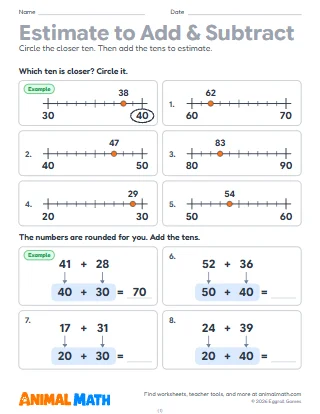
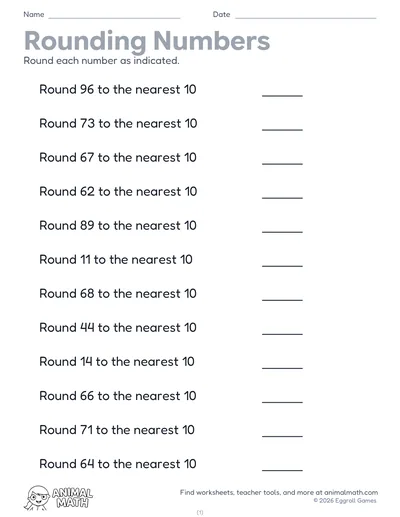
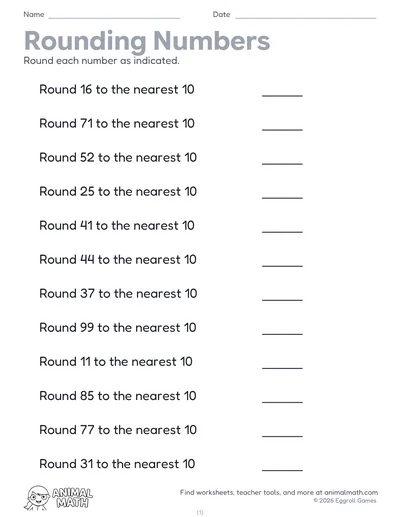
Five pages on knowing when an estimate is enough. Page 1 has eight short situations, like about how many people came to the fair or how much change Jay should get: students circle Estimate or Exact, and tell why on the last two. Page 2 has five word problems with numbers to 1,000 and room to work: students decide first, then round to the nearest hundred for an estimate or work out the exact answer, and the key shows both. On page 3 children share their answers, like 389 + 412 = 701: students estimate each one and circle Yes or No for reasonable. Page 4 turns to measuring: cutting a shelf to fit, giving medicine and weighing a puppy at the vet need exact measurements, while how tall a tree is or how much milk goes on cereal can be estimated. Page 5 chooses sensible units, such as inches or yards for a pencil, and finishes sentences like "A door is about 7 ___ tall."
Start with a quick sort on the board: write "Estimate" and "Exact" at the top and read a few situations aloud, like paying at a store or telling a friend about how many kids are in the school. Ask students what clue words they hear, such as about, around and enough. On page 3, ask students to find the mistake in each answer that is not reasonable. Before page 5, pass around a ruler, a yardstick, a cup and a gallon jug so students can feel how big each unit is.
Talk about estimates during the day: about how long will the drive take, about how much will the groceries cost, is $10 enough for two snacks? Then ask when you need the exact number, like when you pay or follow a recipe for medicine. Let your child guess the length of a table in feet, then measure it together.
This pack supports the following Common Core State Standards for Mathematics:
© Copyright 2010. National Governors Association Center for Best Practices and Council of Chief State School Officers. All rights reserved.
A 5-page estimating pack for 3rd grade. Decide whether a situation needs an estimate or an exact answer, like about how many people came to the fair or how much change to give, and tell why. Choose, then solve addition and subtraction word problems to 1,000 by rounding to the nearest hundred or working out the exact answer, and use an estimate to check whether a child's answer is reasonable. Then decide whether a measurement should be exact or estimated, and choose units that make sense, like feet for a door and gallons for a bathtub. Every page comes in color and in black and white. Answer keys included.
Tell us what to make next, or build your own with a worksheet maker.
This worksheet is free to download, print, copy, and hand out in your classroom or at home. You do not need to create an account, and there are no watermarks on the PDF.