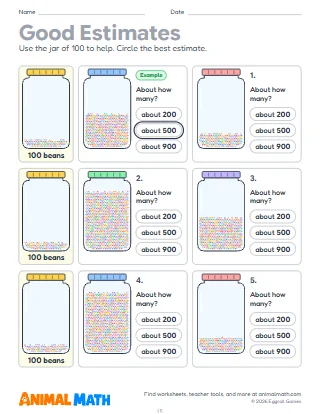
Five pages on estimating how many. Page 1 shows a group of 10 in a loop beside a bigger group of the same things: students use it to circle about 20, about 50 or about 100; the first row is done as an example. Page 2 has six jars of buttons, marbles and jelly beans with up to 38 in each: students circle the best of three estimates, then count and write the real number. On page 3 five children guess how many are in a group, and students circle too few, about right or too many. Page 4 has two big groups, 64 strawberries and 108 ducks: write an estimate first, then circle groups of 10 and write how many tens, ones and in all. On page 5 children say an estimate; students circle yes or no and write about how many groups of 10 they see, then tell which of two groups has more.
Fill a clear jar with 10 cubes, then another with about 50, and let the class guess before you count together by tens. Ask how the jar of 10 helped. On page 2, have students estimate first and count second, and talk about how close they were: a good estimate is close, not exact. Read the children's guesses on pages 3 and 5 aloud.
Estimate at snack time: about how many crackers are in the bowl, or grapes on the plate? Make a guess, then count by making groups of 10. Try it with toys, coins in a jar or steps across a room, and see whose guess was closest.
This pack supports the following Common Core State Standards for Mathematics:
© Copyright 2010. National Governors Association Center for Best Practices and Council of Chief State School Officers. All rights reserved.
A 5-page estimating pack for 1st grade. Use a group of 10 to tell whether a bigger group is about 20, about 50 or about 100, circle the best estimate for jars of buttons, marbles and jelly beans and then count them, and decide whether a child's guess is too few, about right or too many. Estimate two big groups of up to 120, then circle groups of 10 to count them, and tell whether an estimate makes sense by finding groups of 10. Every page comes in color and in black and white. Answer keys included.
Tell us what to make next, or build your own with a worksheet maker.
This worksheet is free to download, print, copy, and hand out in your classroom or at home. You do not need to create an account, and there are no watermarks on the PDF.