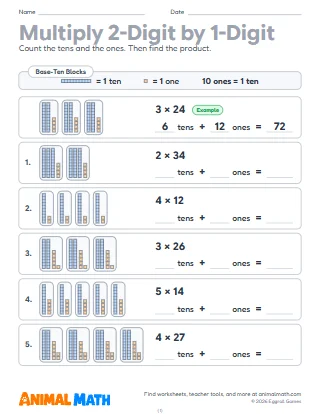
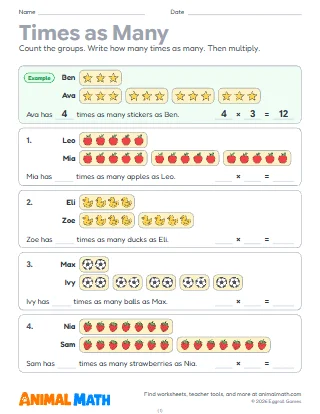
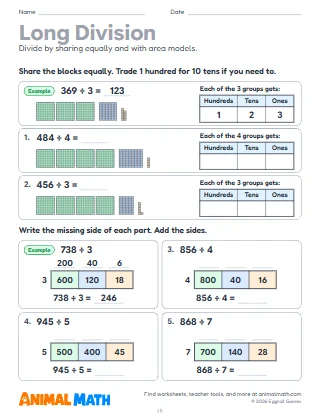
Five pages that move from place value models to the standard algorithm. Page 1 splits a 3- or 4-digit number by place value in an area model: 4 × 326 is 4 × 300, 4 × 20, and 4 × 6, then the parts are added. Page 2 multiplies 2-digit numbers in a four-part area model (47 × 23 is 40 and 7 times 20 and 3) and then writes the same four partial products in a column, with a reminder beside each row. Page 3 is the standard algorithm for 2 digits by 2 digits: multiply by the ones, then by the tens (with a 0 in the ones place), and add, with small boxes for the regrouped digits. Page 4 uses the standard algorithm for 3 and 4 digits by 2 digits. Page 5 rounds each factor to its greatest place to decide whether answers such as 46 × 23 = 230 make sense, then has four story problems that start with an estimate.
Work the example on page 2 together and point out that the four boxes of the area model are the four rows of partial products below it. On page 3, show that the first row of the standard algorithm is the two partial products for the ones added together, and the second row is the two for the tens. Before page 5, ask students to estimate 46 × 23 out loud, then show why 230 cannot be right.
Look for things packed in equal rows or boxes, such as eggs in a crate or seats in a theater, and multiply to find the total. Ask your child to estimate first, then check the exact answer against the estimate.
This pack supports the following Common Core State Standards for Mathematics:
© Copyright 2010. National Governors Association Center for Best Practices and Council of Chief State School Officers. All rights reserved.
A 5-page multiplication pack for 4th and 5th grade. Multiply 3- and 4-digit numbers by 1-digit numbers in area models, then 2-digit by 2-digit numbers in four-part area models and as partial products in a column. Learn the standard algorithm with regrouping for 2 digits by 2 digits, then 3 and 4 digits by 2 digits. Round to estimate, decide whether answers are reasonable, and solve story problems. Every page comes in color and in black and white. Answer keys included.
Tell us what to make next, or build your own with a worksheet maker.
This worksheet is free to download, print, copy, and hand out in your classroom or at home. You do not need to create an account, and there are no watermarks on the PDF.