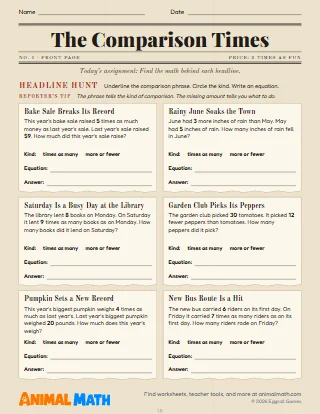
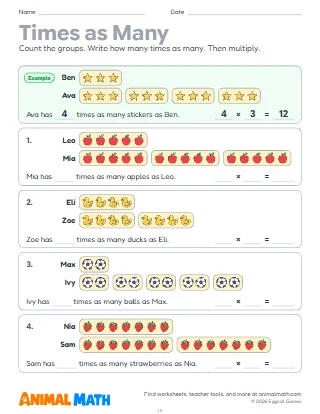
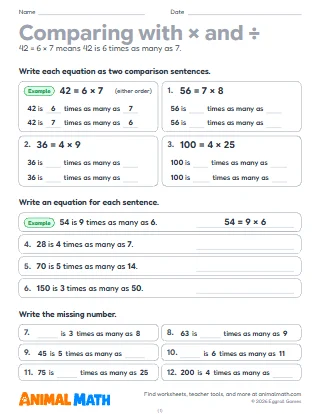
Eight sections of a class newspaper called The Comparison Times, on 13 pages, each built around one question: how does a model help you solve a comparison problem? Page 1 (Headline Hunt) has six news briefs: students underline the comparison, decide whether it is times as many or more or fewer, and write an equation. Pages 2 and 3 (The Equation Desk) read 24 = 3 × 8 two ways, as 24 is 3 times as many as 8 and as 24 is 8 times as many as 3, with a tape diagram for each, then caption news graphics and decide which sentence fits a story. Pages 4 and 5 (Money Matters) are the problem Ken has $5, Mark has 3 times as much, step by step from bills to a tape diagram to 3 × 5 and the total, then two problems to try. Pages 6 and 7 (Diagram Detective) match stories to models, explain a wrong model, finish a model and draw models from scratch. Page 8 (Missing Number Bureau) keeps one story and hides a different number each time, so students see why division solves two of them. Page 9 pairs stories with the same numbers, one more than and one times as many. Pages 10 and 11 (Reporter’s Notebook) have two classroom articles to log and solve, then a page for phrases from real books, magazines and news and a news brief of the student’s own. Pages 12 and 13 (The Fact-Check Desk) are a memo from the editor: check two claims, repair a graphic, prove two more claims and write two true headlines.
Start with page 4 and real or play money: hand one student a $5 bill and another three, and ask who has 3 times as much. Draw the same thing as a tape diagram on the board, Ken’s one box under Mark’s three. Use pages 2, 3 and 9 for partner talk: one partner reads a sentence, the other says what is compared to what. Pages 12 and 13 make a good challenge at the end of the unit.
Look for comparisons together in a newspaper, a sports page or a recipe: twice as many, 3 more than, 5 times as long. Ask your child which amount is being compared to which, and whether it is “more than” or “times as many.” Then make up a question each phrase could answer.
This pack supports the following Common Core State Standards for Mathematics:
© Copyright 2010. National Governors Association Center for Best Practices and Council of Chief State School Officers. All rights reserved.
A newspaper-themed collection about comparison problems: times as many, more than and fewer than, and how a model shows the difference. Students read headlines and articles, draw tape diagrams, find the bigger amount, the smaller amount or the multiplier, fact-check reporters’ claims and explain their thinking.
Tell us what to make next, or build your own with a worksheet maker.
This worksheet is free to download, print, copy, and hand out in your classroom or at home. You do not need to create an account, and there are no watermarks on the PDF.