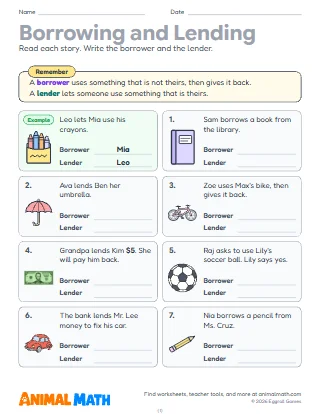
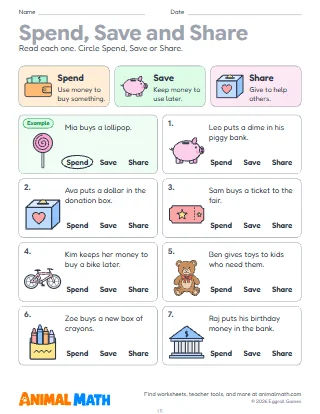
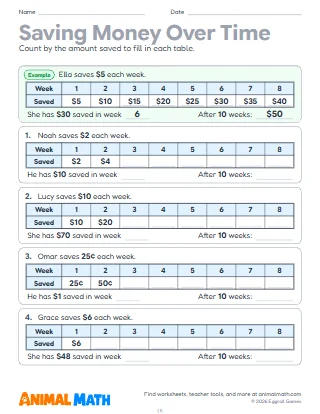
Five pages about planning how money is spent. Page 1 starts with a reminder (planned spending is decided ahead, with a list or a budget; unplanned spending is decided on the spot) and has eight short stories: students circle planned or unplanned. The first is done as an example. On page 2 students add up three shopping plans, from school supplies to a $300 class trip, and find the money left in each budget; in the last box they plan a picnic of their own from a menu. Page 3 has six stories where something unplanned is bought first: students find the money left and circle whether it is still enough for the plan. Page 4 circles cost or benefit for an unplanned and a planned choice, then compares prices paid ahead with prices paid on the spot: how much more for one, and for four. Page 5 sorts ten money decisions into earn, spend, save, borrow and give, then solves two money plans.
Before page 1, ask the class about the last time they bought something: did they plan it, or decide right there? Sort a few answers on the board under Planned and Unplanned. For page 2, hand out a simple menu with prices and let small groups plan a class party within a budget, then share how much they have left. Page 4 is a good place for a talk: an unplanned buy is not always a bad choice (an umbrella in the rain), but it often costs more.
Make a shopping list together before a trip to the store and set a budget. At the store, add up the list as you go and talk about anything you were tempted to add. At home, ask your child whether a recent buy was planned or unplanned, and what it cost and what it gave.
This pack supports the following Common Core State Standards for Mathematics:
© Copyright 2010. National Governors Association Center for Best Practices and Council of Chief State School Officers. All rights reserved.
A 5-page planned and unplanned spending pack for 3rd grade. Read eight short stories and circle planned or unplanned, then add up three shopping plans, find the money left in each budget and make a picnic plan of your own. Solve six stories where an unplanned buy comes first and decide whether there is still enough for the plan, circle the costs and benefits of a planned and an unplanned choice, and compare prices paid ahead with prices paid on the spot. Last, sort ten money decisions into earn, spend, save, borrow and give, and solve two money plans. Every page comes in color and in black and white. Answer keys included.
Tell us what to make next, or build your own with a worksheet maker.
This worksheet is free to download, print, copy, and hand out in your classroom or at home. You do not need to create an account, and there are no watermarks on the PDF.