In New Zealand, summer runs from December to February. It is the long school holiday, and a day at the beach often means a stop at the dairy for an ice block, a scoop of ice cream or a thickshake. These pages suit the last weeks of the school year and the first weeks back.
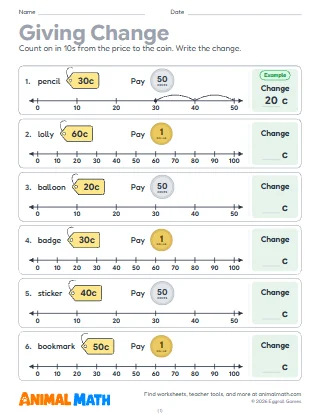
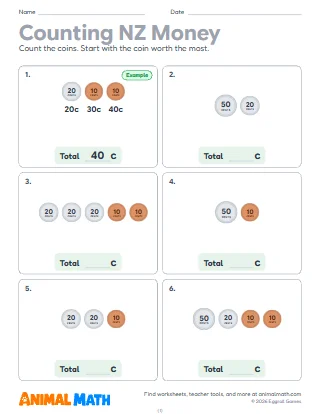
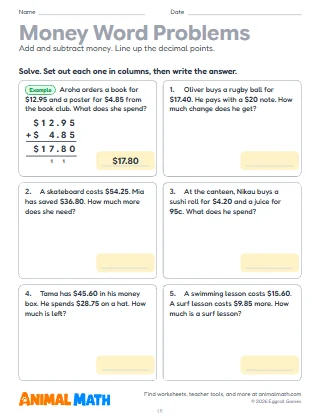
Five pages at the beach dairy, with one price list on every page. On page 1 children count the coins that pay for an ice block, a single scoop or a slice of watermelon, starting with the coin worth the most, and write the price in cents. Page 2 adds the prices of two things, so most totals go over $1 and are written as $1 and 20c. Page 3 counts notes and coins for a milkshake, a slice of pavlova or a box of ice blocks and writes the price in dollars and cents. On page 4 children pay with a $5 note: they count on from the price to the next dollar, then on to $5, and write the change. Page 5 is six word problems about the dairy: totals, change from $5 and $10, and how much more one thing costs. The first problem on pages 1 to 4 is worked as an example. Every price is in 10c steps, as New Zealand has had no 5c coin since 2006, and amounts are written in dollars and cents with no decimal point.
Set up a class dairy with the prices from the pages and play money, and let children take turns behind the counter. Before page 4, act out paying with a $5 note: the shopkeeper counts the change into the buyer's hand, starting from the price. Read the word problems aloud together and ask children to say what they need to find before they work it out.
Next time you buy an ice block or an ice cream, let your child count out the coins, starting with the biggest. Ask how much change you should get from $5 and count it on together. At home, write prices on a few things and play shop with real coins.
New Zealand money practice at the beach dairy in the summer holidays, with ice blocks, scoops, milkshakes and pavlova. Children count coins and notes, add two prices, count on from a price to $5 to give change, and solve shop word problems in dollars and cents.
Tell us what to make next, or build your own with a worksheet maker.
This worksheet is free to download, print, copy, and hand out in your classroom or at home. You do not need to create an account, and there are no watermarks on the PDF.