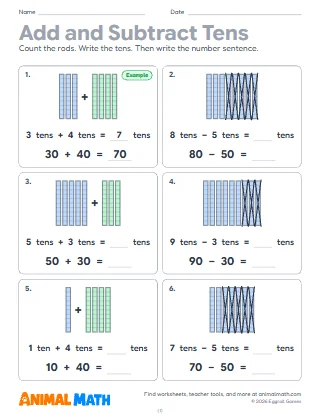
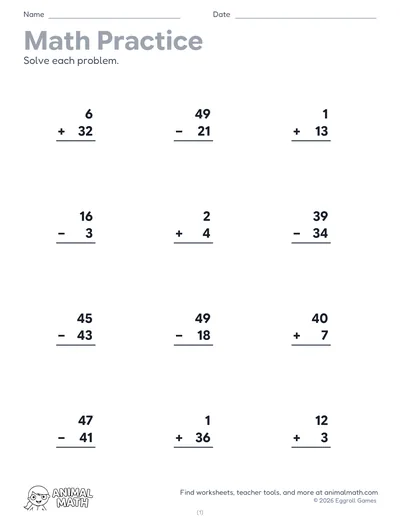
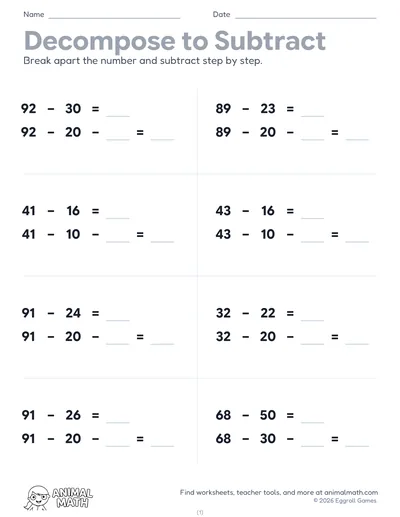
Five pages on adding a two-digit and a one-digit number, the 1st grade step past facts within 20. Page 1 shows a number in base-ten blocks and a few more ones, where the ones stay under ten (32 + 5): students write the tens and ones and the sum. Page 2 makes a new ten: the tens are rods and the ones sit in a ten frame, and students draw the new dots to fill the frame first, then the rest in a second frame (38 + 5 is 4 tens 3 ones, 43). Page 3 breaks apart the second number to reach the next ten: 47 + 6 is 47 + 3 = 50, then 50 + 3 = 53. Page 4 does the same on a number line marked in ones: hop to the next ten, then hop the rest. Page 5 mixes both kinds and asks whether a new ten was made, then shows two animals with different answers (one adds the 5 to the tens, one forgets the new ten, one writes 213 for 33); students circle who is right and show how they know. Each page starts with a worked example.
Before page 2, build 38 with 3 rods and 8 cubes on a ten frame and add 5 cubes one at a time. Stop when the frame is full and ask what just happened (a new ten), then trade the full frame for a rod. For page 3, ask "How many more to get to the next ten?" before every problem. Page 5 makes a good talk: read the animals' answers aloud and let partners argue which one is right before they write.
Ask questions like "You have 47 stickers and get 6 more. How many now?" and ask how your child got the answer. Counting dimes and pennies works well: 3 dimes and 8 pennies, then 5 more pennies. Trade 10 pennies for a dime when you can.
This pack supports the following Common Core State Standards for Mathematics:
© Copyright 2010. National Governors Association Center for Best Practices and Council of Chief State School Officers. All rights reserved.
A 5-page 1st grade pack for adding a one-digit number to a two-digit number within 100, with and without making a new ten. Count base-ten blocks to add when the ones stay under ten (32 + 5), then draw the new dots in ten frames to fill a new ten (38 + 5 = 43). Break apart the second number to make a ten (47 + 6: 47 + 3 = 50, 50 + 3 = 53) and hop to the next ten on a number line. Last, add and say whether you made a new ten, then decide which animal is right and show how you know. Every page comes in color and in black and white. Answer keys included.
Tell us what to make next, or build your own with a worksheet maker.
This worksheet is free to download, print, copy, and hand out in your classroom or at home. You do not need to create an account, and there are no watermarks on the PDF.