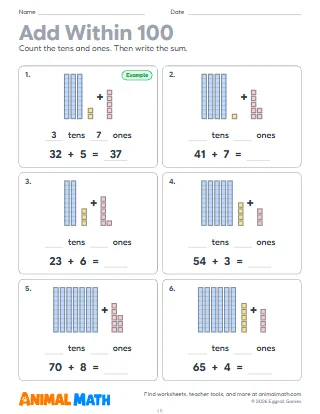
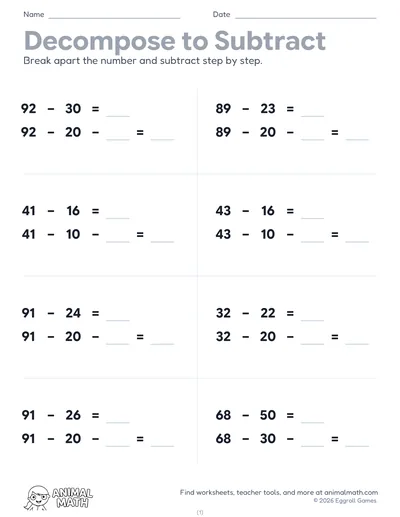
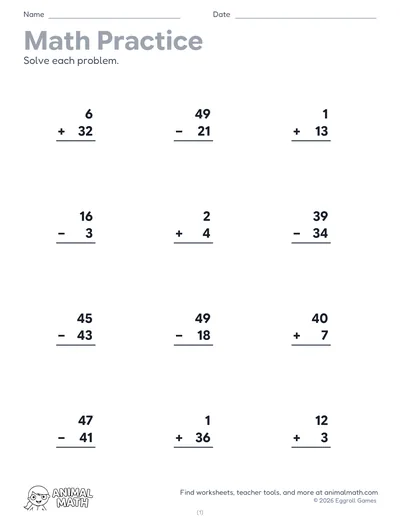
Five pages on adding and subtracting tens, the 1st grade step from facts within 10 to numbers within 100. Page 1 shows ten rods: 3 rods and 4 more rods, or 7 rods with 4 crossed out. Students write the tens (3 tens + 4 tens = 7 tens) and then the number sentence (30 + 40 = 70). Page 2 pairs a fact with its tens fact: 4 + 3 = 7, so 40 + 30 = 70. Then come twelve tens facts up to 100, three with a missing number. Page 3 adds tens to a number that is not a ten, like 34 + 20: students count on by tens in boxes (34, 44, 54) and write the sum. Page 4 hops by tens on an open number line, forward for adding and back for subtracting (78 − 30: 68, 58, 48). Page 5 takes tens away by breaking the first number apart: 86 is 80 and 6, 80 − 30 = 50, and 50 + 6 = 56, with blocks to cross out. Each page starts with a worked example.
Before page 1, hold up 3 ten rods and then 4 more and ask how many tens there are, then how many ones that is. Say it both ways: 7 tens, 70. For page 2, write 5 + 2 = 7 on the board and ask what 50 + 20 must be, and why. On pages 3 and 4, count on by tens out loud from a number like 34, tapping a rod or a hop each time. For page 5, build 86 with blocks, take away 3 rods and ask what happened to the 6 ones (nothing).
Use dimes as tens: 3 dimes and 4 dimes are 7 dimes, or 70 cents. Ask quick questions like "What is 50 + 30?" and "What is 34 + 20?" Count on by tens from any number together: 26, 36, 46, 56. Then count back.
This pack supports the following Common Core State Standards for Mathematics:
© Copyright 2010. National Governors Association Center for Best Practices and Council of Chief State School Officers. All rights reserved.
A 5-page 1st grade pack for adding and subtracting tens within 100. Count ten rods to add and subtract tens (3 tens + 4 tens = 7 tens, so 30 + 40 = 70), then use a fact you know: 4 + 3 = 7, so 40 + 30 = 70. Add tens to any number with base-ten blocks, counting on by tens from 34 to 44 to 54, and hop forward and back by tens on an open number line. Last, break a number into tens and ones to take tens away: 86 is 80 and 6, 80 − 30 = 50, and 50 + 6 = 56. Every page comes in color and in black and white. Answer keys included.
Tell us what to make next, or build your own with a worksheet maker.
This worksheet is free to download, print, copy, and hand out in your classroom or at home. You do not need to create an account, and there are no watermarks on the PDF.