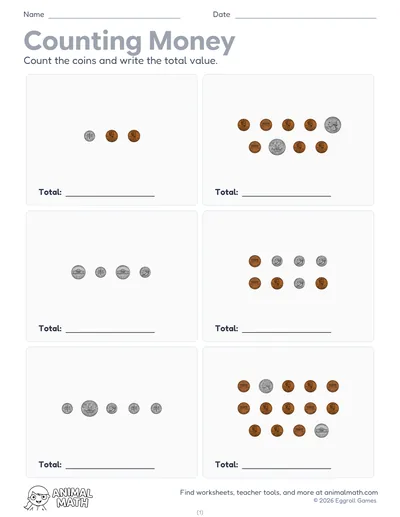
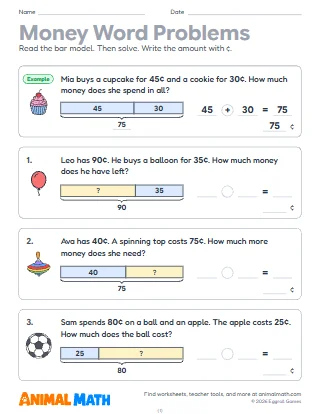
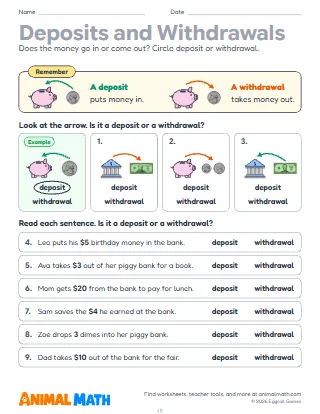
Seven pages for the money unit of 2nd grade. Page 1 is a pre-check to give before the unit, on what it builds on: naming coins, counting dimes, nickels and pennies, counting by 5s and 10s, adding and subtracting within 100, and trading coins. Pages 2 and 3 are a review to do together before the test. Pages 4 and 5 are the unit test, Form A. Pages 6 and 7 are Form B: the same questions in the same order with different coins and amounts, for a retake, a make-up or a second seating. Each form has 12 questions, one point each, and a Score line on its first page. Coins and bills are drawn from real money pictures, coins at their true sizes next to each other.
Give the pre-check on the first day of the unit and sort the class by what they missed. Do the review the day before the test, with play coins and bills on the tables. Coins alone are written in cents (45¢) and bills in dollars ($45), and question 4 asks students to choose the right one; bills and coins counted together make dollars and cents, written $6.76. Questions 10 to 12 (saving over time, deposits, withdrawals and borrowing, producers and consumers) are taught in 2nd grade in Texas: leave them out if your class does not learn them and score out of 9. The answer keys name each question's skill, so a missed question points to the lesson to reteach.
Use the review as practice before a test at school, or Form B as a check after the unit. Empty a pocket or a coin jar and count it together, starting with the coins worth the most. Ask your child to make the same amount two different ways.
This pack supports the following Common Core State Standards for Mathematics:
© Copyright 2010. National Governors Association Center for Best Practices and Council of Chief State School Officers. All rights reserved.
A unit test for money in 2nd grade: a one-page pre-check, a two-page review, and the unit test in two forms (A and B).
Tell us what to make next, or build your own with a worksheet maker.
This worksheet is free to download, print, copy, and hand out in your classroom or at home. You do not need to create an account, and there are no watermarks on the PDF.