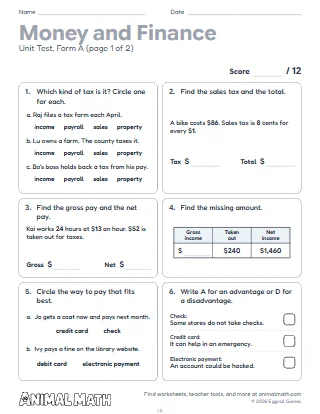
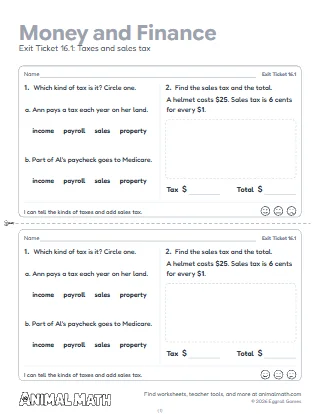
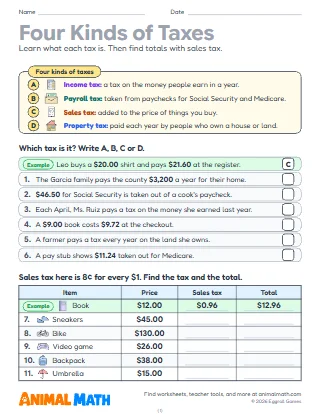
Two pages that go over the whole 5th grade money and financial literacy unit, to do together the day before the test. Its 12 questions are the same kinds as the test's, in the same order, with other money and stories: two for each lesson. There is no Score line: it is practice, not a grade. People, families and amounts are made up. No question asks a problem from the unit's exit tickets or the practice sheets. The pre-check and the unit test are packs of their own.
Do the review together the day before the test. Work a question, then let students try the next one on their own, and stop on any that trip up more than a few. If your class learned the lessons at different times of the year, do the questions for the lessons it was taught. The keys name each question's lesson, so a question the class misses points to the lesson to go back to.
Use the review as practice before a test at school. Make a simple monthly budget for a pretend family together, and decide what to change if the expenses come to more than the income.
This pack supports the following Common Core State Standards for Mathematics:
© Copyright 2010. National Governors Association Center for Best Practices and Council of Chief State School Officers. All rights reserved.
A review of the unit on taxes, income, ways to pay, records and budgets, to go over together the day before the test. Students name kinds of taxes, work out sales tax, gross and net pay and running balances, weigh ways to pay, and balance budgets.
Tell us what to make next, or build your own with a worksheet maker.
This worksheet is free to download, print, copy, and hand out in your classroom or at home. You do not need to create an account, and there are no watermarks on the PDF.