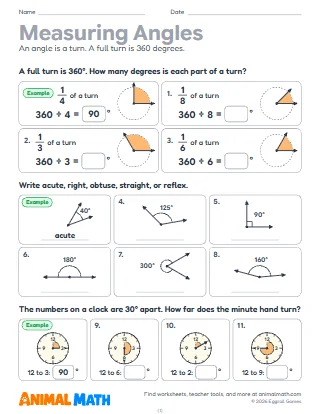
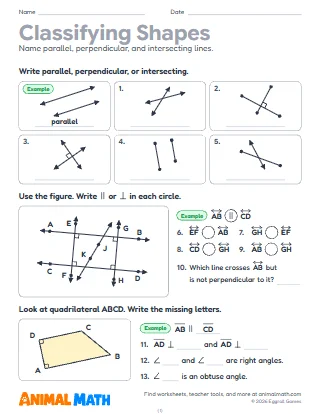
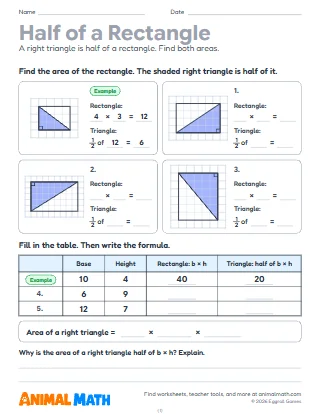
Five pages on angles and the angles of a triangle. Page 1 sorts angles by sight into acute, right, obtuse and straight, then measures angles with your own protractor (every angle is drawn at its true size, so it measures the same on any printer) and picks the right tool for a job. Page 2 tears the three corners off a triangle and lines them up: together they make a straight angle, 180°. Then students measure the angles of four triangles and add them, and the sum is always 180°. Page 3 finds the unknown angle of a triangle by subtracting the two angles it knows from 180 (180 − 62 − 45 = 73), right triangles included, then uses tick marks and arcs on isosceles triangles: the equal angles are marked the same way. Page 4 names triangles by their angles and by their sides from their measures and marks, and asks which triangles can exist: two right angles leave nothing for the third angle. Page 5 finds unknown angles on a straight line (180°), in a right angle (90°) and around a point (360°), then two story problems. Every page starts with a worked example.
Before page 2, have every student cut out a paper triangle of any shape, tear off its three corners and fit them together at a point on a straight line. Every triangle in the room makes the same straight angle. Then compare measured sums on page 2: a sum of 179° or 181° is a measuring slip, which is a good moment to practice lining up the protractor again.
Look for triangles around the house: a slice of sandwich, a roof, a coat hanger. Ask whether each one has a right angle, an obtuse angle or only acute angles, and whether any of its sides look equal. If you have a protractor, measure two corners and predict the third before measuring it.
This pack supports the following Common Core State Standards for Mathematics:
© Copyright 2010. National Governors Association Center for Best Practices and Council of Chief State School Officers. All rights reserved.
Angles sorted and measured, and why the three angles of every triangle add up to 180°. Students sort and measure angles, tear and measure the corners of triangles, find unknown angles in triangles and diagrams, and name triangles by their angles and sides.
Tell us what to make next, or build your own with a worksheet maker.
This worksheet is free to download, print, copy, and hand out in your classroom or at home. You do not need to create an account, and there are no watermarks on the PDF.