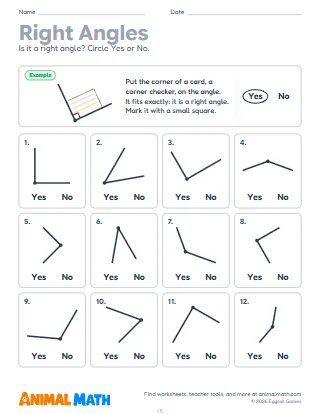
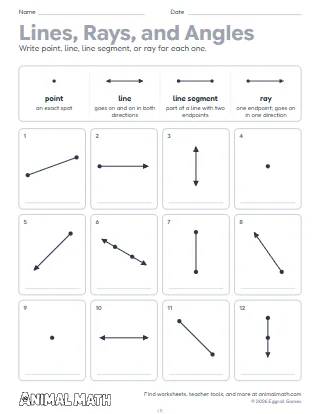
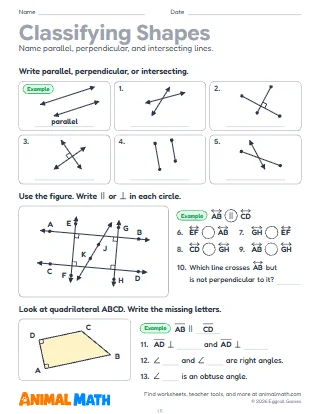
Five pages on angles and protractors. Page 1 treats an angle as a turn: a full turn is 360°, so a quarter turn is 360 ÷ 4 = 90° and a sixth of a turn is 60°. It names acute, right, obtuse, straight, and reflex angles, and counts the degrees a clock's minute hand turns. Page 2 reads angles drawn on a printed protractor: start from the 0 that the first ray passes through, on the inner or the outer scale, and check that an acute angle reads less than 90. Page 3 is measured with your own protractor: single angles, a slice of pizza, and the angles of a triangle and a four-sided shape. Every angle is drawn at its true size, so it measures the same on any printer. Page 4 draws angles of a given size from a ray. Page 5 finds unknown angles: when an angle is split into parts, the parts add up to the whole, so 35° + a = 90° and a = 55°.
Before page 1, have students stand and turn a quarter turn, a half turn, and a full turn, and say the degrees. Before page 2, show on a large protractor that both scales name the same angles from opposite ends, and ask how to tell which number to read. On page 3, have partners check each other: line up the center mark on the vertex and the 0 line on one ray.
Find angles around the house: an open door, the hands of a clock, a slice of pizza. Ask your child whether each one is acute, right, or obtuse, and estimate its size before measuring it with a protractor.
This pack supports the following Common Core State Standards for Mathematics:
© Copyright 2010. National Governors Association Center for Best Practices and Council of Chief State School Officers. All rights reserved.
A 5-page angles pack for 4th grade. See an angle as a turn: a degree is 1/360 of a full turn, so a quarter turn is 360 ÷ 4 = 90°. Name acute, right, obtuse, straight, and reflex angles, read angles on a printed protractor with its inner and outer scales, measure angles and the angles of shapes with your own protractor, draw angles of a given size, and find unknown angles by adding and subtracting, with an equation. Every page comes in color and in black and white. Answer keys included.
Tell us what to make next, or build your own with a worksheet maker.
This worksheet is free to download, print, copy, and hand out in your classroom or at home. You do not need to create an account, and there are no watermarks on the PDF.