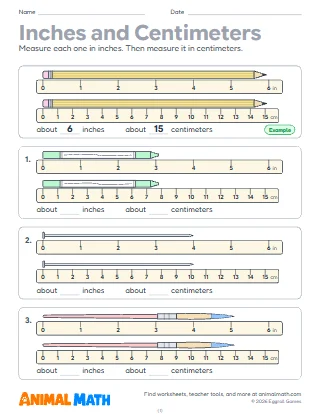
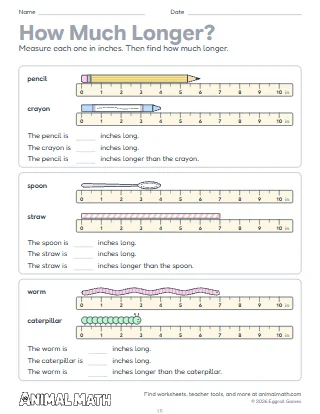
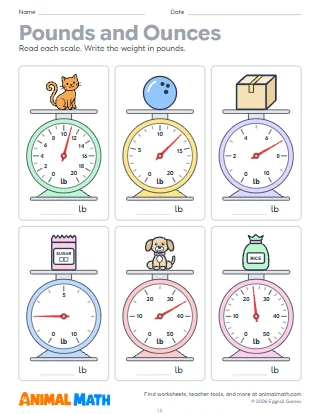
Five pages on which tool measures what. Page 1 shows the three tools at the top, then nine questions: how long, how heavy, or how much it holds; students circle the ruler, the scale or the measuring cup. Page 2 matches each tool to what it measures and to its unit, then asks for the tool and the unit for six everyday jobs. Page 3 has six dial scales marked in pounds to read, and two questions that compare the weights. Page 4 reads three measuring jugs to the cup and measures three things on an inch ruler to the nearest inch. Page 5 circles the better estimate (a cat weighs about 10 pounds, not 100) and compares real things whose pictures are not to scale.
Set a ruler, a kitchen scale and a measuring cup on a table. Hold up things from the room one at a time and ask a question about each: how long is this book, how heavy is this bag, how much water fits in this cup? Students point to the tool, say the unit, then one student measures.
Look for measuring tools at home together: a ruler or tape measure, a bathroom scale, a measuring cup in the kitchen. Ask your child what each one tells you, then weigh a bag of groceries, measure a spoon and fill a bowl one cup at a time.
This pack supports the following Common Core State Standards for Mathematics:
© Copyright 2010. National Governors Association Center for Best Practices and Council of Chief State School Officers. All rights reserved.
A 5-page 2nd grade pack on picking the right tool: a ruler for how long, a scale for how heavy and a measuring cup for how much a container holds. Circle the tool for nine questions, match each tool to what it measures and to its unit (inches, pounds, cups), and pick the tool and the unit for six jobs. Read dial scales to the pound and compare the weights, read measuring jugs to the nearest cup, measure things on an inch ruler to the nearest inch, then circle the better estimate and the heavier, lighter, shorter or bigger one. Every page comes in color and in black and white. Answer keys included.
Tell us what to make next, or build your own with a worksheet maker.
This worksheet is free to download, print, copy, and hand out in your classroom or at home. You do not need to create an account, and there are no watermarks on the PDF.