Five pages of compare stories within 20, where two amounts are set side by side. On page 1 the two groups of pictures are lined up one under the other, so students can match them and count the extra ones. Page 2 asks how many fewer. Page 3 shows a two-bar model for each story: one bar for each person, with a question mark for the difference or the missing amount. Page 4 gives one amount and how many more or fewer the other has (Sam has 6 fewer strawberries than Mia). Page 5 is the challenge: "Kai has 11. That is 4 fewer than Ella has" means Ella has more, so you add. Pages 1 to 4 start with a worked example.
Make two cube trains for the first story on page 1 and stand them side by side: the extra cubes are the difference. On page 5, ask students to say who has more before they write anything, and draw two bars to check. These stories are hard in 1st grade; working them together is fine.
Line up two rows of spoons or toy cars and ask how many more are in the longer row. Then turn it around: how many fewer are in the shorter row? It is the same number, asked two ways.
This pack supports the following Common Core State Standards for Mathematics:
© Copyright 2010. National Governors Association Center for Best Practices and Council of Chief State School Officers. All rights reserved.
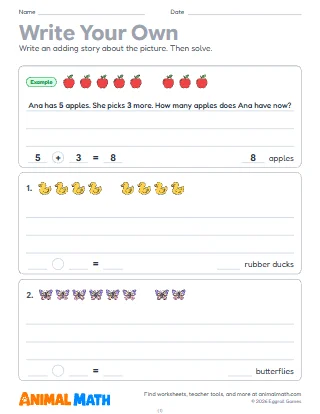
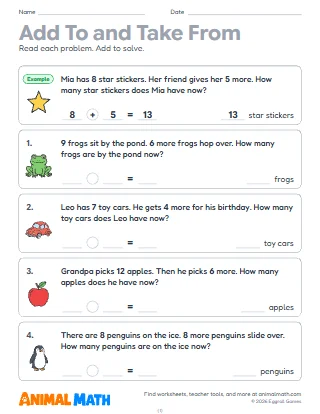
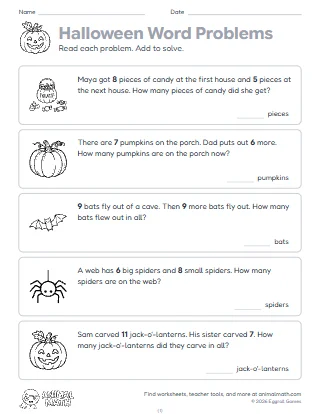
A 5-page compare word problems pack for 1st grade, with numbers within 20. Line up two groups of pictures to see how many more, solve how many fewer stories, and use two-bar models to compare. Then find the bigger or smaller amount ("Leo has 5 more toy cars than Ben") and finish with the tricky stories whose words point the other way ("That is 4 fewer than Ella has"). Every page comes in color and in black and white. Answer keys included.
Tell us what to make next, or build your own with a worksheet maker.
This worksheet is free to download, print, copy, and hand out in your classroom or at home. You do not need to create an account, and there are no watermarks on the PDF.