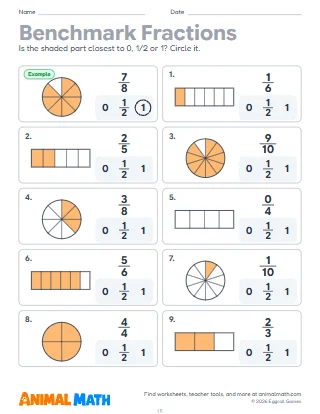
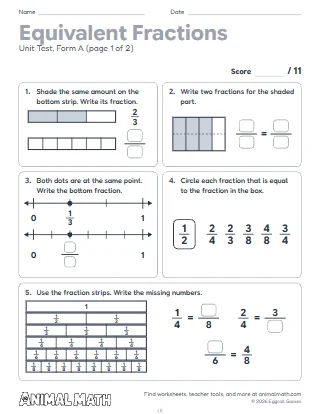
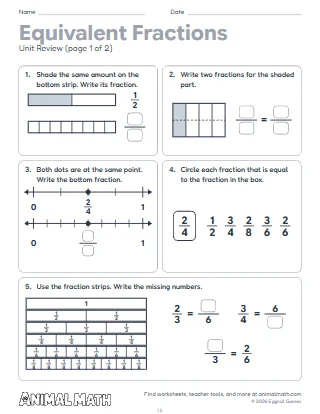
Five pages on comparing fractions that share a denominator or a numerator, with denominators 2, 3, 4, 6 and 8. On page 1 students shade two fractions with the same denominator on strips or circles of the same size, like 5/8 and 3/8, and write >, < or =, with a worked example first. Page 2 does the same with the same numerator, like 2/3 and 2/6: fewer parts in the whole means bigger parts. Page 3 has no models: students write the sign and circle the reason, "same size parts, more of them" or "same number of parts, bigger parts", then decide whether Lily is right that 2/6 is greater than 2/4 because 6 is greater than 4. Page 4 puts three fractions in order from least to greatest, then marks two fractions on number lines and compares them. Page 5 has six stories: four with wholes of the same size, and two with a small and a big whole, where the bigger fraction is not the bigger amount.
Give each pair of students fraction strips of the same length. For page 1, lay 3/8 and 5/8 side by side: the parts are the same size, so count them. For page 2, lay 2/3 and 2/6 side by side: there are 2 parts of each, so the bigger parts win. Before page 5, cut 1/2 from a small paper circle and 1/4 from a big one, and ask which piece is bigger and why the fractions alone do not tell.
Cut two slices of bread or two pieces of paper the same size. Cut one into 4 equal parts and the other into 8, then ask your child which is more, 3 of the fourths or 3 of the eighths, and why. Try it again with the same number of parts: 2 of 6 and 5 of 6.
This pack supports the following Common Core State Standards for Mathematics:
© Copyright 2010. National Governors Association Center for Best Practices and Council of Chief State School Officers. All rights reserved.
Comparing fractions that have the same denominator or the same numerator, with halves, thirds, fourths, sixths and eighths. Students shade strips and circles, write >, < and =, explain each comparison, put fractions in order, use number lines and solve stories where the wholes must be the same size.
Tell us what to make next, or build your own with a worksheet maker.
This worksheet is free to download, print, copy, and hand out in your classroom or at home. You do not need to create an account, and there are no watermarks on the PDF.