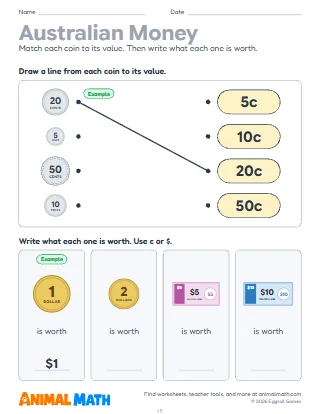
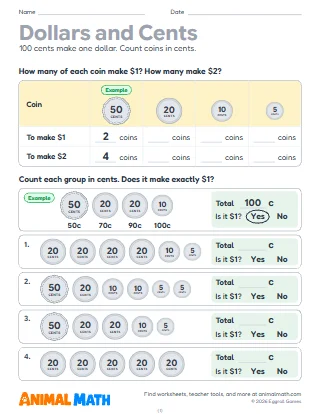
Five pages on counting Australian money and using it, for Years 1 and 2. Page 1 has groups of coins under $1, laid out with the coin worth the most first: children count on and write the total in cents; the first group shows the count under each coin. Page 2 counts dollars: $1 and $2 coins with $5, $10, $20 and $50 notes. Page 3 shows $1 coins in piles of ten on trays with some loose coins: children count the piles in tens, then the loose coins in ones. Page 4 is a toy shop with prices in whole dollars: children find what two or three toys cost, how much more one costs than another, the change from a $10 or $20 note, and whether there is enough money for two toys. Page 5 asks for each amount with the fewest coins and notes, from 15c to $15; there is only one fewest way for each. The coins and notes are our own drawings, in the real shapes, colours and sizes.
Set out a tray of play money before page 1 and count a handful together, biggest first, out loud: 50, 70, 80, 85. For page 3, stack real or play $1 coins in tens and count the stacks first. Turn page 4 into a class shop with the same five toys and prices, and let children take turns buying and giving change.
Count the coins in a purse or money box together, biggest first. Make piles of ten $1 coins, or ten 10c coins, and count by tens. When you shop, ask your child which notes and coins you could use, and how much change you should get back.
This pack supports the following Common Core State Standards for Mathematics:
© Copyright 2010. National Governors Association Center for Best Practices and Council of Chief State School Officers. All rights reserved.
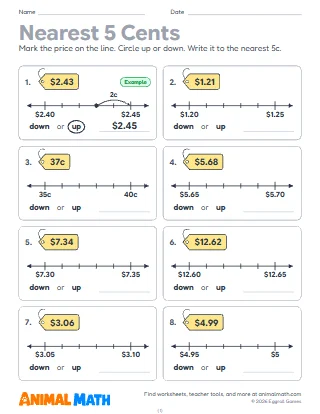
Counting Australian coins and notes and buying things in whole dollars. Students count coins in cents, count dollars in coins and notes, count $1 coins in piles of ten, answer questions about a toy shop, and make amounts with the fewest coins and notes.
Tell us what to make next, or build your own with a worksheet maker.
This worksheet is free to download, print, copy, and hand out in your classroom or at home. You do not need to create an account, and there are no watermarks on the PDF.