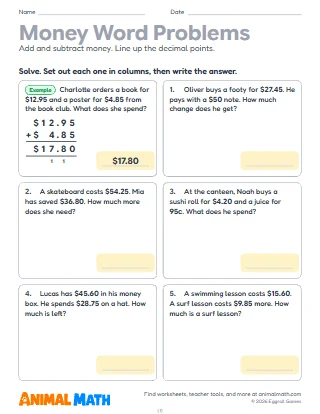
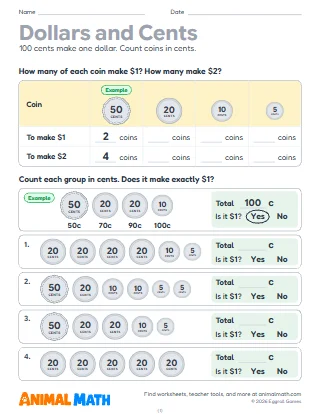
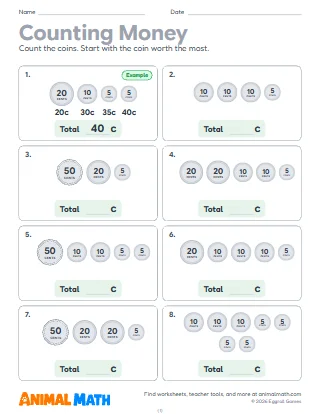
Five pages on paying cash in Australia, where the smallest coin is 5c, so a cash total is rounded to the nearest 5 cents: an amount ending in 1c or 2c rounds down to 0, 3c or 4c up to 5c, 6c or 7c down to 5c, and 8c or 9c up to the next 10c. On page 1 children find a price on a number line with a tick for every cent, circle up or down and write the price to the nearest 5c, so $2.43 becomes $2.45 and 37c becomes 35c. Page 2 adds two or three prices: when the story says cash, the total is rounded, and when it says card, it is not, so children see the difference. Page 3 rounds a price, writes it at the start of an open number line and counts on to a $5, $10 or $20 note to find the change. On page 4 children round each price to the nearest dollar to estimate, then find the exact total and the cash total and decide whether the money is enough; twice the estimate and the cash total disagree. Page 5 is a corner shop with price tags: children add the things bought, round the total for cash, find the change from a note and write how many of each coin and note make the change with the fewest pieces. The first problem on each page is worked as an example.
Start with a class shop and a pile of play coins with no 1c or 2c coins in it, and ask how you could pay exactly $2.43. Then draw a number line from $2.40 to $2.45 and find the nearer end together. Before page 2, compare two receipts for the same shopping, one paid in cash and one by card. For page 3, count on out loud from the cash price: "$3.60, $4, $5, so the change is $1.40." On page 4, ask whether an estimate is good enough to decide if $10 will pay, and talk about the stories where it is not.
Look at a shop receipt together and find the total. Ask what you would pay in cash, rounded to the nearest 5 cents, and what you would pay by card. When you pay cash, let your child work out the change before it is given, counting on from the price to the note.
This pack supports the following Common Core State Standards for Mathematics:
© Copyright 2010. National Governors Association Center for Best Practices and Council of Chief State School Officers. All rights reserved.
Paying cash in Australia, where there are no 1c or 2c coins, so a cash total is rounded to the nearest 5 cents. Students round prices and totals, compare paying cash with paying by card, estimate before they shop and count on to find the change.
Tell us what to make next, or build your own with a worksheet maker.
This worksheet is free to download, print, copy, and hand out in your classroom or at home. You do not need to create an account, and there are no watermarks on the PDF.