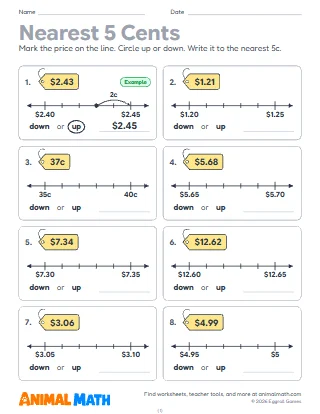
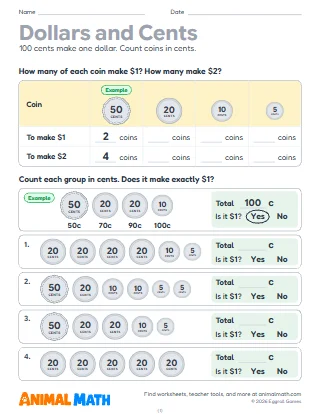
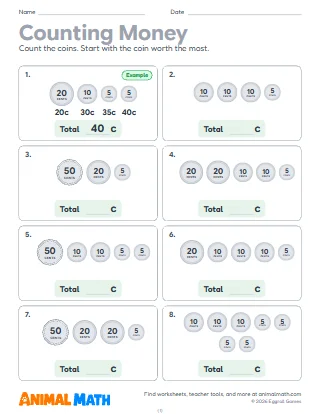
Five pages of money stories in Australian dollars and cents for Year 4 and Year 5. Page 1 adds and subtracts: a book club order, change from a $50 note, how much more is needed, and 95c written as $0.95 so it lines up under $4.20. Students set each story out in columns lined up on the decimal point. Page 2 multiplies: 5 toy scooters at $96 each worked as 5 × $100 take off 5 × $4, then short multiplication (4 bus fares at $3.45 each) and "three times as much" stories. Page 3 divides: shares with short division, every answer in whole cents, then the price of one muesli bar from a pack of 6, a quarter of a pocket money amount and the cost of a helmet when a scooter costs three times as much. Page 4 rounds each amount to the nearest dollar or $10, estimates the answer and decides whether a child’s answer is reasonable, then finds the exact answer. Page 5 is a Year 5 sausage sizzle with a shopping list, a price list and a $200 goal: costs, takings, profit and how many sausage sizzles to sell. Each section starts with a worked example, and the answer keys show carried digits under the answer, exchanges above the top number, the remainders carried in short division and the working for every story.
Before page 1, write 95c and $0.95 on the board and ask why the 9 goes in the 10c column. On page 2, talk through 5 × $96 as a class first: is it easier to work out 5 × $100 and take off a little? Page 4 makes a good discussion: ask how the children with unreasonable answers might have gone wrong (a decimal point in the wrong place). Page 5 works well in groups: after the questions, let each group plan its own fundraiser with prices and a goal.
Use a shopping docket or a catalogue. Estimate the total of a few items by rounding each price to the nearest dollar, then add them exactly and compare. Work out the change from a $20 or $50 note, and the price of one item in a multipack.
This pack supports the following Common Core State Standards for Mathematics:
© Copyright 2010. National Governors Association Center for Best Practices and Council of Chief State School Officers. All rights reserved.
Money stories in Australian dollars and cents, from a book club order and swimming lessons to a class sausage sizzle. Students add, subtract, multiply and divide amounts, estimate to check whether an answer is reasonable and plan a fundraiser with costs, takings and profit.
Tell us what to make next, or build your own with a worksheet maker.
This worksheet is free to download, print, copy, and hand out in your classroom or at home. You do not need to create an account, and there are no watermarks on the PDF.