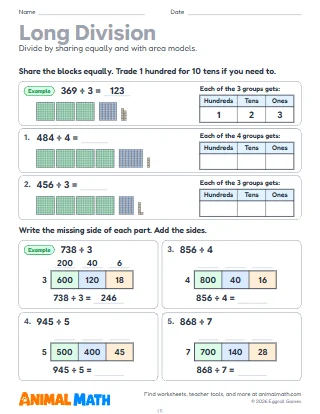
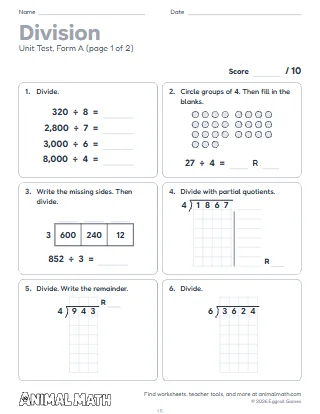
Five pages on dividing by two-digit numbers, each starting with a worked example. Page 1 divides with a fact you know (48 ÷ 6 = 8, so 480 ÷ 60 = 8 and 4,800 ÷ 60 = 80) and then estimates with compatible numbers: round the divisor to the nearest ten and pick a dividend close by that divides easily, so 3,175 ÷ 42 is about 3,200 ÷ 40 = 80. Page 2 breaks the dividend into parts with area models, where every part but the last is given and the last is what is left, then divides with partial quotients. Page 3 is the standard algorithm: each digit is estimated by rounding the divisor, and students check the estimate, fixing it when the product is more than the number (too big) or when what is left is not less than the divisor (too small). Page 4 has four- and five-digit dividends with zeros in the quotient, then writes each remainder three ways, such as 41 R 6 = 41 6/24 = 41 1/4 = 41.25, the fraction in simplest form. Page 5 answers one division four ways, then four stories that start with an estimate and end with what the remainder means: round up, drop it, the remainder is the answer, or share it as a fraction or a decimal.
Before page 1, write 48 ÷ 6, 480 ÷ 60 and 4,800 ÷ 60 on the board and ask why the first two have the same answer. On page 3, have partners say each estimate out loud and decide together whether it is too big, too small or just right before writing anything. On page 5, read the example's four questions aloud: the division is the same, but the answers are 29, 28, 24 and $28.75.
Use big numbers from everyday life: 1,000 minutes of screen time a month is about how many minutes a day? How many cartons of 12 are needed for 150 eggs? Estimate first, then divide, then ask what to do with the remainder.
This pack supports the following Common Core State Standards for Mathematics:
© Copyright 2010. National Governors Association Center for Best Practices and Council of Chief State School Officers. All rights reserved.
Division with two-digit divisors, from dividing with a fact and estimating to the standard algorithm and what a remainder means. Students divide by multiples of 10, estimate with compatible numbers, use area models and partial quotients, check and fix each estimated digit, and write remainders after R, as fractions and as decimals.
Tell us what to make next, or build your own with a worksheet maker.
This worksheet is free to download, print, copy, and hand out in your classroom or at home. You do not need to create an account, and there are no watermarks on the PDF.