Loading preview...

Features

  • Forms A and B ask the same questions with different numbers
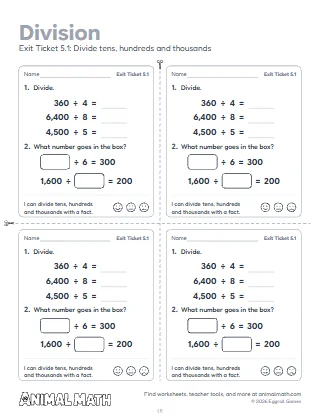
  • Divide tens, hundreds and thousands with a fact, like 2,800 ÷ 7
  • Circle equal groups and write the quotient and the remainder
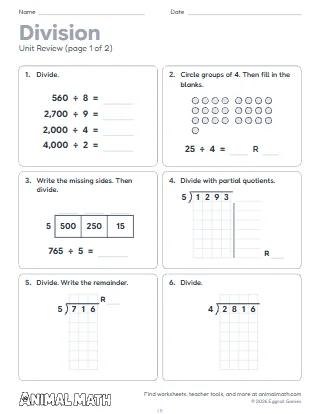
  • Write the missing sides of an area model, then divide
  • Divide with partial quotients and with long division, remainders included
  • Divide a 4-digit number with a zero in the quotient
  • Estimate with numbers that divide easily, and decide whether a quotient is reasonable
  • Decide what a remainder means in a story, and divide to compare
  • Answer keys name the lesson and skill of every question

Skills Covered

  • Divide tens, hundreds and thousands with a fact
  • Remainders: what is left over
  • Divide with an area model
  • Partial quotients
  • Long division with a remainder
  • 4-digit dividends and zeros in the quotient
  • Estimate a quotient with numbers that divide easily
  • Is the quotient reasonable?
  • What the remainder means in a story
  • Divide to compare: times as many

How to Use This Pack

The unit test for the fifth unit of 4th grade, dividing multi-digit numbers. Pages 1 and 2 are Form A. Pages 3 and 4 are Form B: the same questions in the same order with different numbers, for a retake, a make-up or a second seating. Each form has 10 questions, one point each, and a Score line on its first page. Every question is on a Common Core lesson. The pre-check and the unit review are packs of their own.

In the Classroom

Give Form A the day after the unit review. Questions 1 and 7 hold more than one problem: give the point when all are right, or score them by the problem if you like. The keys show partial quotients by place value (hundreds, then tens, then ones); other partial quotients that add to the same quotient are right too. In the estimate question any numbers that divide easily will do, and the compare story may be written as a division or as a multiplication with a letter. The answer keys name each question's skill, so a missed question points to the lesson to reteach.

At Home

Use Form B as a check after the unit. Ask your child to check each quotient by multiplying it by the divisor and adding the remainder.

Tips for Success

  • Think of 2,800 ÷ 7 as 28 hundreds ÷ 7
  • Divide, multiply, subtract, bring down, then do it again
  • Write a 0 in the quotient when the divisor does not go into a place
  • Check: the quotient times the divisor, plus the remainder, is the dividend
  • Use Form B as a retake after reteaching what was missed

Common Core Standards Alignment

This pack supports the following Common Core State Standards for Mathematics:

  • 4.OA.A.1 Read a multiplication equation as a comparison (24 = 3 × 8: 24 is 3 times as many as 8) and write comparisons as equations.
  • 4.OA.A.2 Multiply or divide to solve story problems that compare amounts (times as many), using drawings and equations, and tell them apart from comparing by adding.
  • 4.OA.A.3 Solve multi-step story problems with whole numbers and all four operations, deciding what remainders mean, writing equations with a letter, and checking by estimating.
  • 4.NBT.B.6 Divide numbers up to 9,999 by one-digit numbers, finding quotients and remainders with place-value strategies shown in equations, arrays or area models.
  • 5.NBT.A.2 Explain why multiplying or dividing by 10, 100 or 1,000 adds zeros or moves the decimal point, and write powers of 10 with exponents.

© Copyright 2010. National Governors Association Center for Best Practices and Council of Chief State School Officers. All rights reserved.

4th Grade Division Test

The unit test on dividing multi-digit numbers by a 1-digit number in two forms, from dividing tens, hundreds and thousands to long division with a zero in the quotient. Students find remainders, use area models, partial quotients and long division, estimate quotients and solve remainder and compare stories.

Download PDF
Pin

What’s Included

  • The unit test in two forms, A and B (10 questions each)
  • Answer keys that name each question's lesson and skill (8 pages in all)
Can’t find what you need?

Tell us what to make next, or build your own with a worksheet maker.

Suggest a worksheet

Free to print and share

This worksheet is free to download, print, copy, and hand out in your classroom or at home. You do not need to create an account, and there are no watermarks on the PDF.