4th Grade Math Curriculum

A full year of 4th grade math in 15 units and 127 lessons, free to print. Every lesson has a one-page lesson plan (how to teach it, the words to use, the mistakes to watch for) and an exit ticket, and every unit has a pre-check, a review and a test in two forms. Each lesson plan points to the worksheets, worksheet makers, teaching tools and quizzes that practice it. The plan below counts one lesson a day, with a day for the pre-check, the review and the test of each unit: 172 days, which leaves room in a 180-day year for catching up, holidays and seasonal packs.
15 units127 lessons172 days35 weeks

Unit 1

Place Value

Weeks 1–2 · 10 days

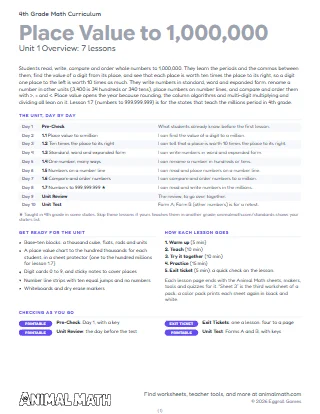
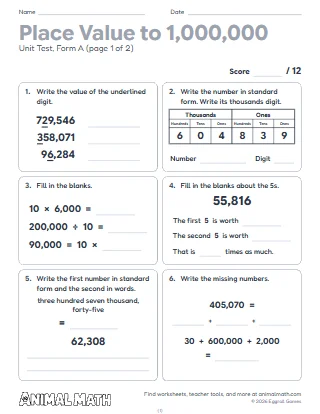
Students read, write, compare and order whole numbers to 1,000,000. They learn the periods and the commas between them, find the value of a digit from its place, and see that each place is worth ten times the place to its right, so a digit one place to the left is worth 10 times as much. They write numbers in standard, word and expanded form, rename a number in other units (3,400 is 34 hundreds or 340 tens), place numbers on number lines, and compare and order them with >, = and <. Place value opens the year because rounding, the column algorithms and multi-digit multiplying and dividing all lean on it. Lesson 1.7 (numbers to 999,999,999) is for the states that teach the millions period in 4th grade.

Week 1
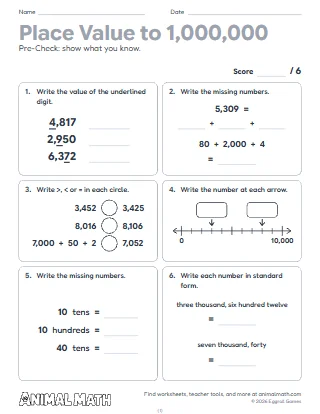
Day 1Pre-CheckWhat students already know, before the unit.
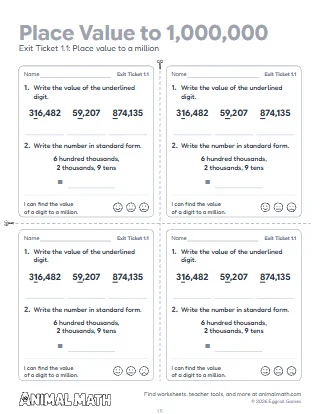
Day 21.1 Place value to a millionI can find the value of a digit to a million.
Day 31.2 Ten times the place to its rightI can tell that a place is worth 10 times the place to its right.
Day 41.3 Standard, word and expanded formI can write numbers in word and expanded form.
Day 51.4 One number, many waysI can rename a number in hundreds or tens.
Week 2
Day 61.5 Numbers on a number lineI can read and place numbers on a number line.
Day 71.6 Compare and order numbersI can compare and order numbers to a million.
Day 81.7 Numbers to 999,999,999 ★I can read and write numbers in the millions.
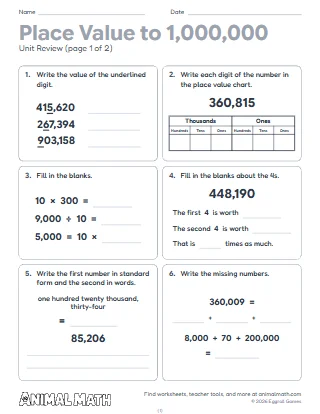
Day 9Unit ReviewThe review, to go over together.
Day 10Unit TestForm A; Form B (other numbers) is for a retest.
Unit 2

Rounding, Adding and Subtracting

Weeks 3–5 · 11 days

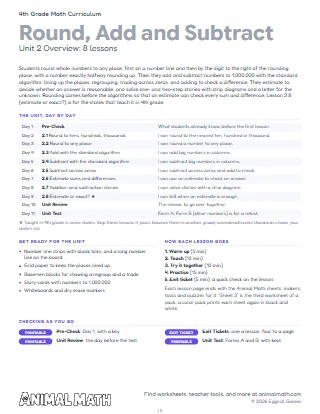
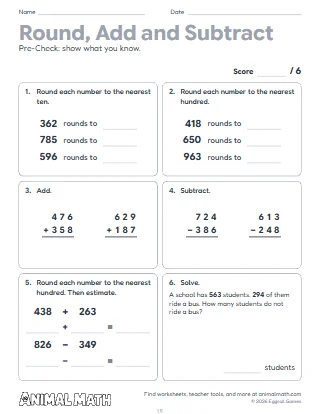
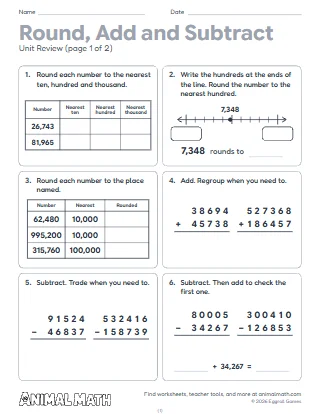
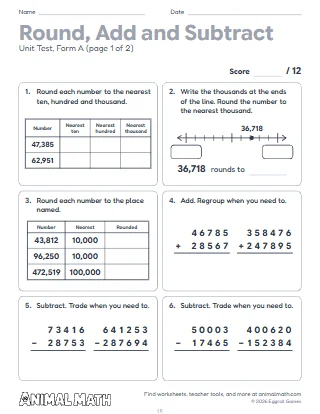
Students round whole numbers to any place, first on a number line and then by the digit to the right of the rounding place, with a number exactly halfway rounding up. Then they add and subtract numbers to 1,000,000 with the standard algorithm: lining up the places, regrouping, trading across zeros, and adding to check a difference. They estimate to decide whether an answer is reasonable, and solve one- and two-step stories with strip diagrams and a letter for the unknown. Rounding comes before the algorithms so that an estimate can check every sum and difference. Lesson 2.8 (estimate or exact?) is for the states that teach it in 4th grade.

Week 3
Day 11Pre-CheckWhat students already know, before the unit.
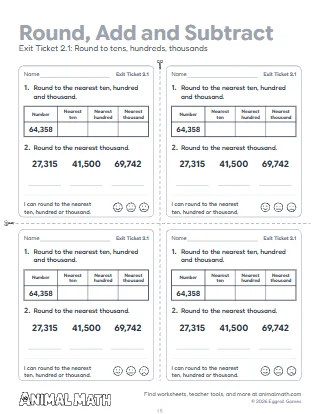
Day 122.1 Round to tens, hundreds, thousandsI can round to the nearest ten, hundred or thousand.
Day 132.2 Round to any placeI can round a number to any place.
Day 142.3 Add with the standard algorithmI can add big numbers in columns.
Day 152.4 Subtract with the standard algorithmI can subtract big numbers in columns.
Week 4
Day 162.5 Subtract across zerosI can subtract across zeros and add to check.
Day 172.6 Estimate sums and differencesI can use an estimate to check an answer.
Day 182.7 Addition and subtraction storiesI can solve stories with a strip diagram.
Day 192.8 Estimate or exact? ★I can tell when an estimate is enough.
Day 20Unit ReviewThe review, to go over together.
Week 5
Day 21Unit TestForm A; Form B (other numbers) is for a retest.
Unit 3

Factors and Multiples

Weeks 5–7 · 12 days

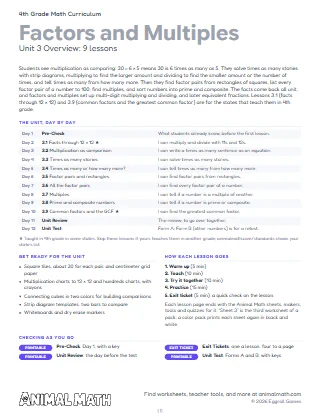
Students see multiplication as comparing: 30 = 6 × 5 means 30 is 6 times as many as 5. They solve times as many stories with strip diagrams, multiplying to find the larger amount and dividing to find the smaller amount or the number of times, and tell times as many from how many more. Then they find factor pairs from rectangles of squares, list every factor pair of a number to 100, find multiples, and sort numbers into prime and composite. The facts come back all unit, and factors and multiples set up multi-digit multiplying and dividing, and later equivalent fractions. Lessons 3.1 (facts through 12 × 12) and 3.9 (common factors and the greatest common factor) are for the states that teach them in 4th grade.

Week 5 (continued)
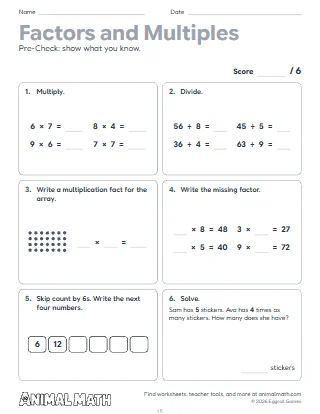
Day 22Pre-CheckWhat students already know, before the unit.
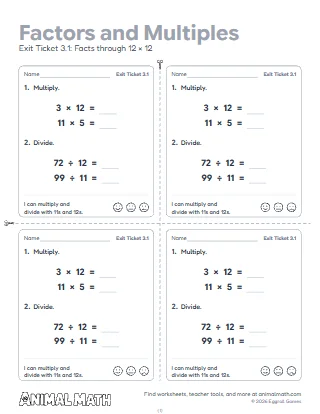
Day 233.1 Facts through 12 × 12 ★I can multiply and divide with 11s and 12s.
Day 243.2 Multiplication as comparisonI can write a times as many sentence as an equation.
Day 253.3 Times as many storiesI can solve times as many stories.
Week 6
Day 263.4 Times as many or how many more?I can tell times as many from how many more.
Day 273.5 Factor pairs and rectanglesI can find factor pairs from rectangles.
Day 283.6 All the factor pairsI can find every factor pair of a number.
Day 293.7 MultiplesI can tell if a number is a multiple of another.
Day 303.8 Prime and composite numbersI can tell if a number is prime or composite.
Week 7
Day 313.9 Common factors and the GCF ★I can find the greatest common factor.
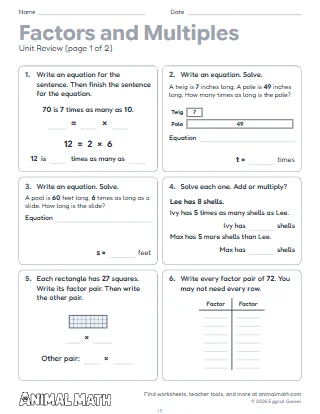
Day 32Unit ReviewThe review, to go over together.
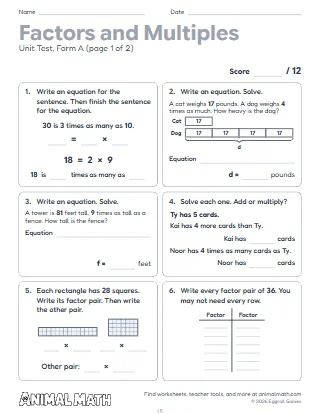
Day 33Unit TestForm A; Form B (other numbers) is for a retest.
Unit 4

Multiplication

Weeks 7–9 · 12 days

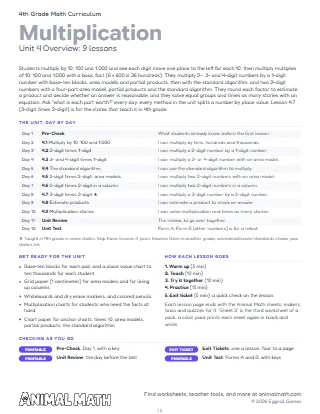
Students multiply by 10, 100 and 1,000 and see each digit move one place to the left for each 10, then multiply multiples of 10, 100 and 1,000 with a basic fact (6 × 600 is 36 hundreds). They multiply 2-, 3- and 4-digit numbers by a 1-digit number with base-ten blocks, area models and partial products, then with the standard algorithm, and two 2-digit numbers with a four-part area model, partial products and the standard algorithm. They round each factor to estimate a product and decide whether an answer is reasonable, and they solve equal groups and times as many stories with an equation. Ask “what is each part worth?” every day: every method in the unit splits a number by place value. Lesson 4.7 (3-digit times 2-digit) is for the states that teach it in 4th grade.

Week 7 (continued)
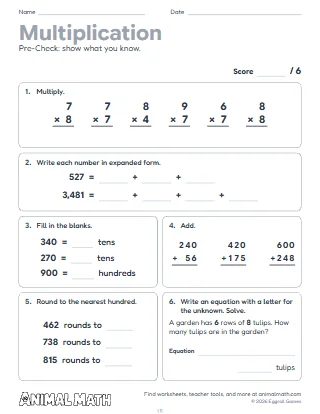
Day 34Pre-CheckWhat students already know, before the unit.
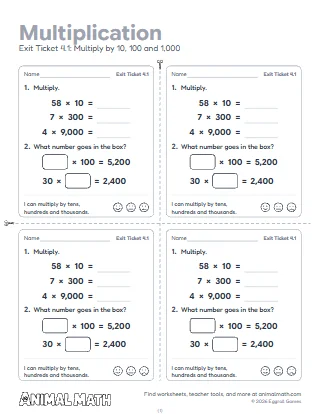
Day 354.1 Multiply by 10, 100 and 1,000I can multiply by tens, hundreds and thousands.
Week 8
Day 364.2 2-digit times 1-digitI can multiply a 2-digit number by a 1-digit number.
Day 374.3 3- and 4-digit times 1-digitI can multiply a 3- or 4-digit number with an area model.
Day 384.4 The standard algorithmI can use the standard algorithm to multiply.
Day 394.5 2-digit times 2-digit: area modelsI can multiply two 2-digit numbers with an area model.
Day 404.6 2-digit times 2-digit in a columnI can multiply two 2-digit numbers in a column.
Week 9
Day 414.7 3-digit times 2-digit ★I can multiply a 3-digit number by a 2-digit number.
Day 424.8 Estimate productsI can estimate a product to check an answer.
Day 434.9 Multiplication storiesI can solve multiplication and times as many stories.
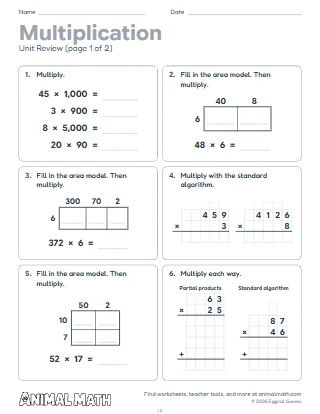
Day 44Unit ReviewThe review, to go over together.
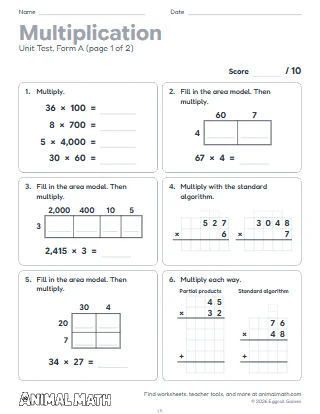
Day 45Unit TestForm A; Form B (other numbers) is for a retest.
Unit 5

Division

Weeks 10–12 · 12 days

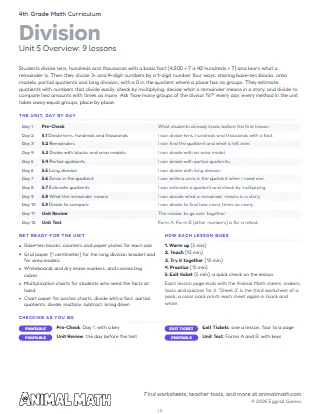
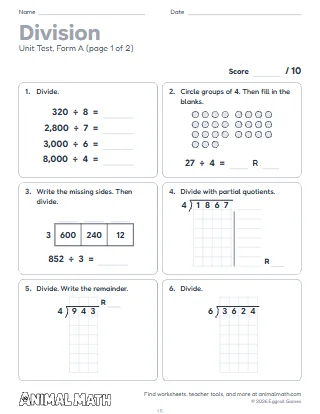
Students divide tens, hundreds and thousands with a basic fact (4,200 ÷ 7 is 42 hundreds ÷ 7) and learn what a remainder is. Then they divide 3- and 4-digit numbers by a 1-digit number four ways: sharing base-ten blocks, area models, partial quotients and long division, with a 0 in the quotient where a place has no groups. They estimate quotients with numbers that divide easily, check by multiplying, decide what a remainder means in a story, and divide to compare two amounts with times as many. Ask “how many groups of the divisor fit?” every day: every method in the unit takes away equal groups, place by place.

Week 10
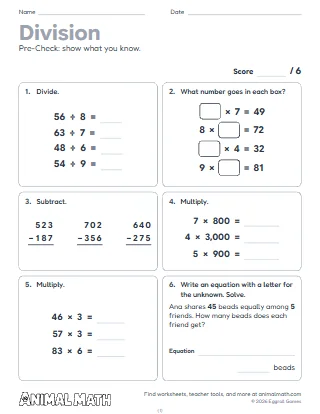
Day 46Pre-CheckWhat students already know, before the unit.
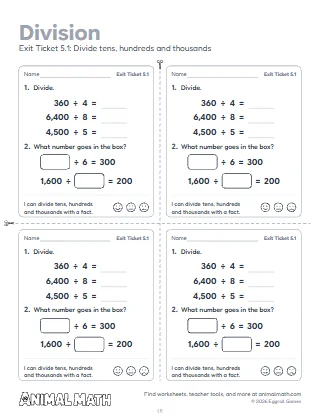
Day 475.1 Divide tens, hundreds and thousandsI can divide tens, hundreds and thousands with a fact.
Day 485.2 RemaindersI can find the quotient and what is left over.
Day 495.3 Divide with blocks and area modelsI can divide with an area model.
Day 505.4 Partial quotientsI can divide with partial quotients.
Week 11
Day 515.5 Long divisionI can divide with long division.
Day 525.6 Zeros in the quotientI can write a zero in the quotient when I need one.
Day 535.7 Estimate quotientsI can estimate a quotient and check by multiplying.
Day 545.8 What the remainder meansI can decide what a remainder means in a story.
Day 555.9 Divide to compareI can divide to find how many times as many.
Week 12
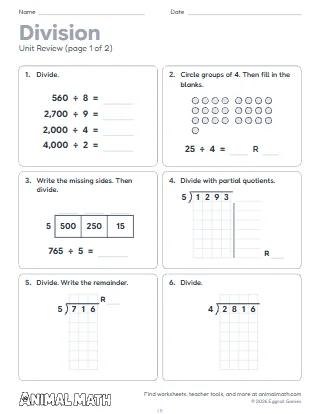
Day 56Unit ReviewThe review, to go over together.
Day 57Unit TestForm A; Form B (other numbers) is for a retest.
Unit 6

Multi-Step Problems and Patterns

Weeks 12–14 · 11 days

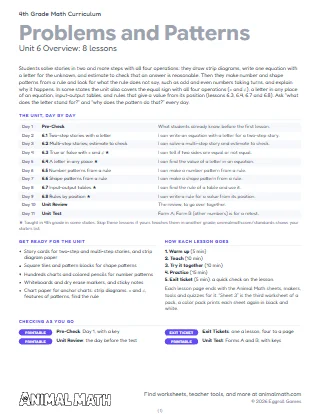
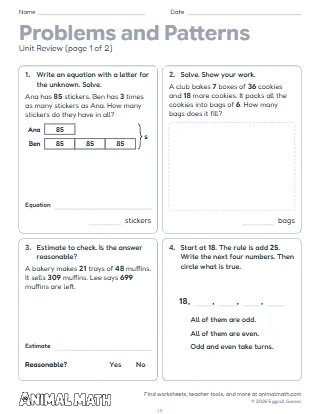
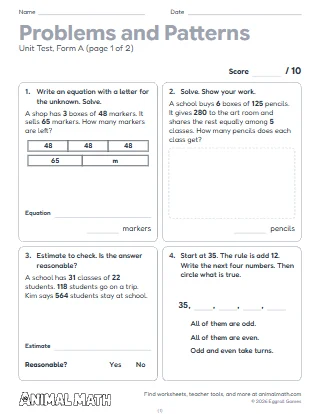
Students solve stories in two and more steps with all four operations: they draw strip diagrams, write one equation with a letter for the unknown, and estimate to check that an answer is reasonable. Then they make number and shape patterns from a rule and look for what the rule does not say, such as odd and even numbers taking turns, and explain why it happens. In some states the unit also covers the equal sign with all four operations (= and ≠), a letter in any place of an equation, input-output tables, and rules that give a value from its position (lessons 6.3, 6.4, 6.7 and 6.8). Ask “what does the letter stand for?” and “why does the pattern do that?” every day.

Week 12 (continued)
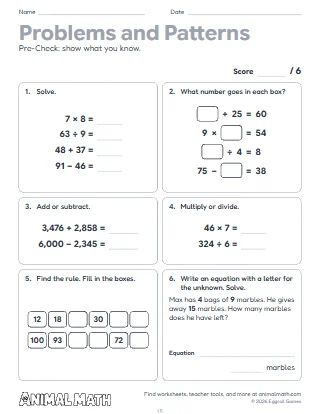
Day 58Pre-CheckWhat students already know, before the unit.
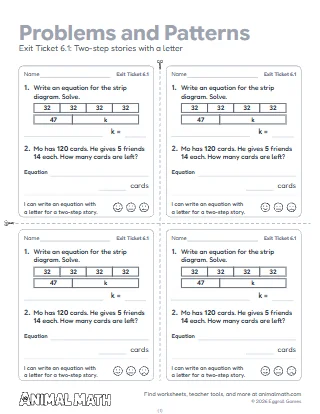
Day 596.1 Two-step stories with a letterI can write an equation with a letter for a two-step story.
Day 606.2 Multi-step stories; estimate to checkI can solve a multi-step story and estimate to check.
Week 13
Day 616.3 True or false with = and ≠ ★I can tell if two sides are equal or not equal.
Day 626.4 A letter in any place ★I can find the value of a letter in an equation.
Day 636.5 Number patterns from a ruleI can make a number pattern from a rule.
Day 646.6 Shape patterns from a ruleI can make a shape pattern from a rule.
Day 656.7 Input-output tables ★I can find the rule of a table and use it.
Week 14
Day 666.8 Rules by position ★I can write a rule for a value from its position.
Day 67Unit ReviewThe review, to go over together.
Day 68Unit TestForm A; Form B (other numbers) is for a retest.
Unit 7

Equivalent and Comparing Fractions

Weeks 14–16 · 10 days

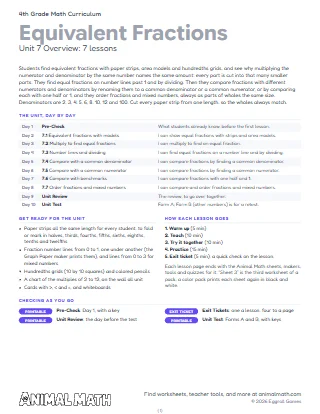
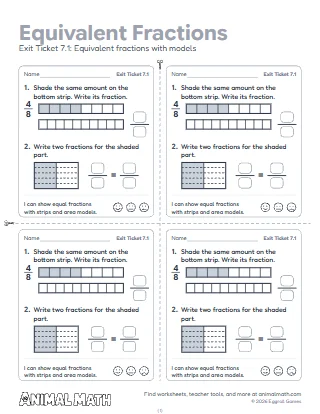
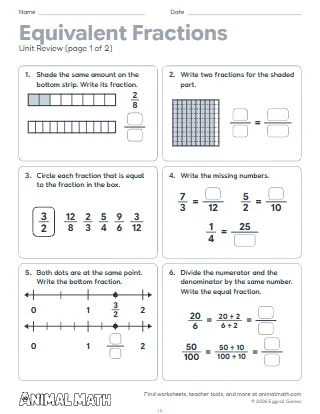
Students find equivalent fractions with paper strips, area models and hundredths grids, and see why multiplying the numerator and denominator by the same number names the same amount: every part is cut into that many smaller parts. They find equal fractions on number lines past 1 and by dividing. Then they compare fractions with different numerators and denominators by renaming them to a common denominator or a common numerator, or by comparing each with one half or 1, and they order fractions and mixed numbers, always as parts of wholes the same size. Denominators are 2, 3, 4, 5, 6, 8, 10, 12 and 100. Cut every paper strip from one length, so the wholes always match.

Week 14 (continued)
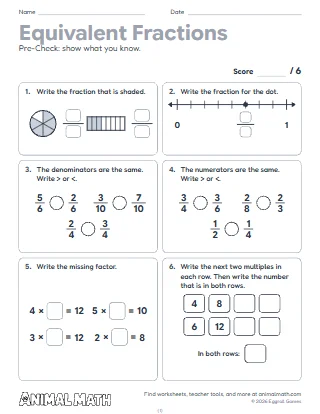
Day 69Pre-CheckWhat students already know, before the unit.
Day 707.1 Equivalent fractions with modelsI can show equal fractions with strips and area models.
Week 15
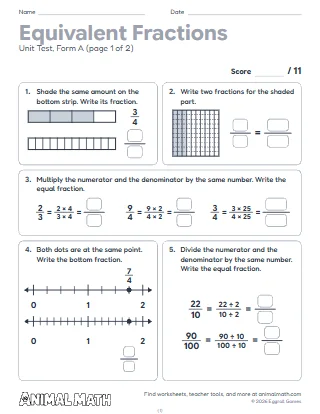
Day 717.2 Multiply to find equal fractionsI can multiply to find an equal fraction.
Day 727.3 Number lines and dividingI can find equal fractions on a number line and by dividing.
Day 737.4 Compare with a common denominatorI can compare fractions by finding a common denominator.
Day 747.5 Compare with a common numeratorI can compare fractions by finding a common numerator.
Day 757.6 Compare with benchmarksI can compare fractions with one half and 1.
Week 16
Day 767.7 Order fractions and mixed numbersI can compare and order fractions and mixed numbers.
Day 77Unit ReviewThe review, to go over together.
Day 78Unit TestForm A; Form B (other numbers) is for a retest.
Unit 8

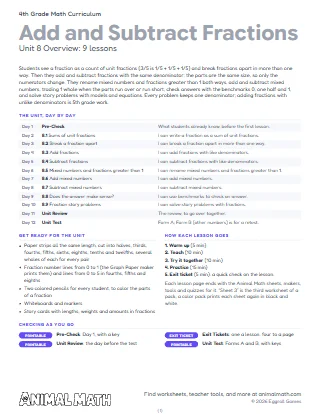
Adding and Subtracting Fractions

Weeks 16–18 · 12 days

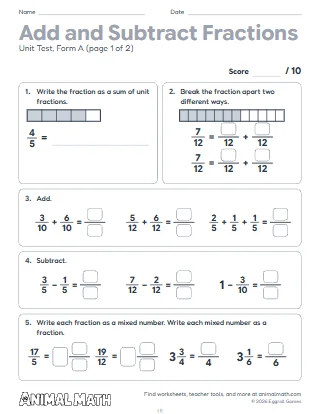
Students see a fraction as a count of unit fractions (3/5 is 1/5 + 1/5 + 1/5) and break fractions apart in more than one way. Then they add and subtract fractions with the same denominator: the parts are the same size, so only the numerators change. They rename mixed numbers and fractions greater than 1 both ways, add and subtract mixed numbers, trading 1 whole when the parts run over or run short, check answers with the benchmarks 0, one half and 1, and solve story problems with models and equations. Every problem keeps one denominator; adding fractions with unlike denominators is 5th grade work.

Week 16 (continued)
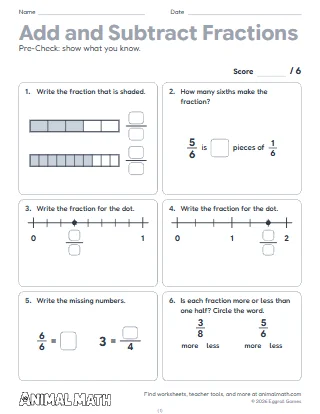
Day 79Pre-CheckWhat students already know, before the unit.
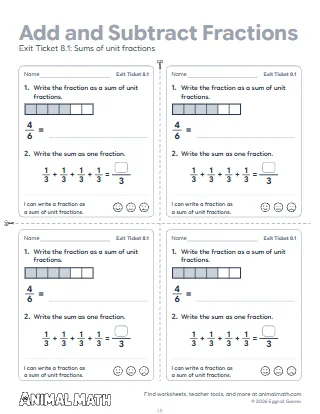
Day 808.1 Sums of unit fractionsI can write a fraction as a sum of unit fractions.
Week 17
Day 818.2 Break a fraction apartI can break a fraction apart in more than one way.
Day 828.3 Add fractionsI can add fractions with like denominators.
Day 838.4 Subtract fractionsI can subtract fractions with like denominators.
Day 848.5 Mixed numbers and fractions greater than 1I can rename mixed numbers and fractions greater than 1.
Day 858.6 Add mixed numbersI can add mixed numbers.
Week 18
Day 868.7 Subtract mixed numbersI can subtract mixed numbers.
Day 878.8 Does the answer make sense?I can use benchmarks to check an answer.
Day 888.9 Fraction story problemsI can solve story problems with fractions.
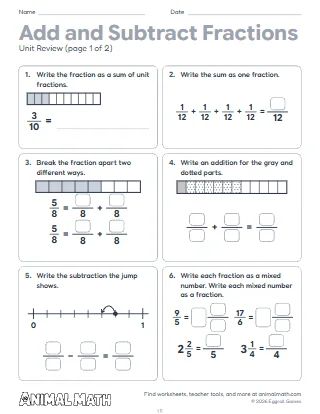
Day 89Unit ReviewThe review, to go over together.
Day 90Unit TestForm A; Form B (other numbers) is for a retest.
Unit 9

Multiplying Fractions

Weeks 19–20 · 9 days

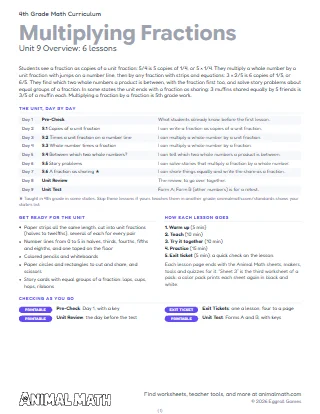
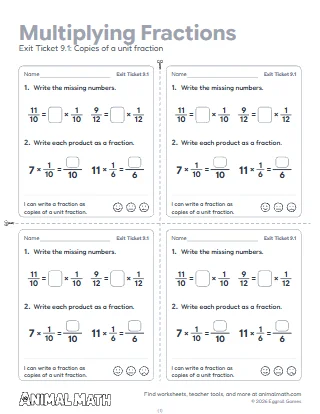
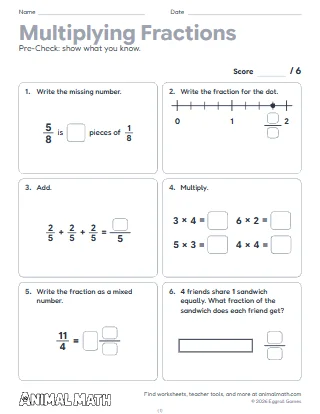
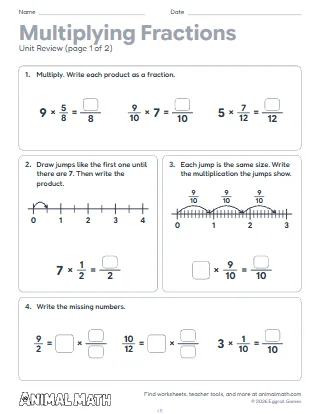
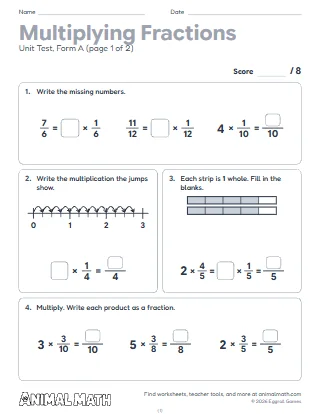
Students see a fraction as copies of a unit fraction: 5/4 is 5 copies of 1/4, or 5 × 1/4. They multiply a whole number by a unit fraction with jumps on a number line, then by any fraction with strips and equations: 3 × 2/5 is 6 copies of 1/5, or 6/5. They find which two whole numbers a product is between, with the fraction first too, and solve story problems about equal groups of a fraction. In some states the unit ends with a fraction as sharing: 3 muffins shared equally by 5 friends is 3/5 of a muffin each. Multiplying a fraction by a fraction is 5th grade work.

Week 19
Day 91Pre-CheckWhat students already know, before the unit.
Day 929.1 Copies of a unit fractionI can write a fraction as copies of a unit fraction.
Day 939.2 Times a unit fraction on a number lineI can multiply a whole number by a unit fraction.
Day 949.3 Whole number times a fractionI can multiply a whole number by a fraction.
Day 959.4 Between which two whole numbers?I can tell which two whole numbers a product is between.
Week 20
Day 969.5 Story problemsI can solve stories that multiply a fraction by a whole number.
Day 979.6 A fraction as sharing ★I can share things equally and write the share as a fraction.
Day 98Unit ReviewThe review, to go over together.
Day 99Unit TestForm A; Form B (other numbers) is for a retest.
Unit 10

Decimals

Weeks 20–23 · 13 days

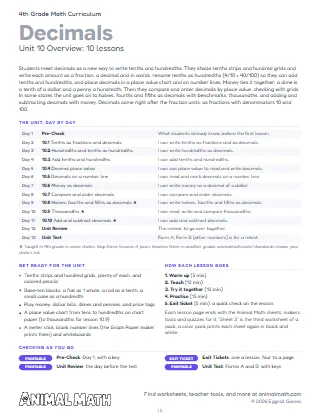
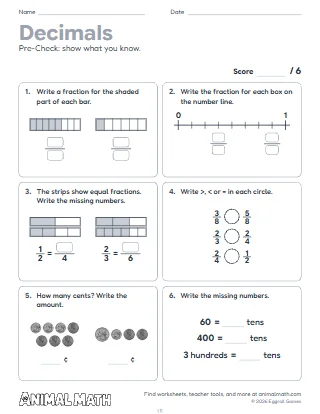
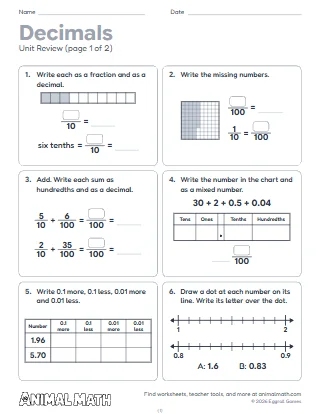
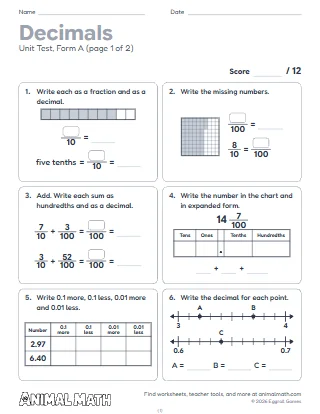
Students meet decimals as a new way to write tenths and hundredths. They shade tenths strips and hundred grids and write each amount as a fraction, a decimal and in words, rename tenths as hundredths (4/10 = 40/100) so they can add tenths and hundredths, and place decimals in a place value chart and on number lines. Money ties it together: a dime is a tenth of a dollar and a penny a hundredth. Then they compare and order decimals by place value, checking with grids. In some states the unit goes on to halves, fourths and fifths as decimals with benchmarks, thousandths, and adding and subtracting decimals with money. Decimals come right after the fraction units, as fractions with denominators 10 and 100.

Week 20 (continued)
Day 100Pre-CheckWhat students already know, before the unit.
Week 21
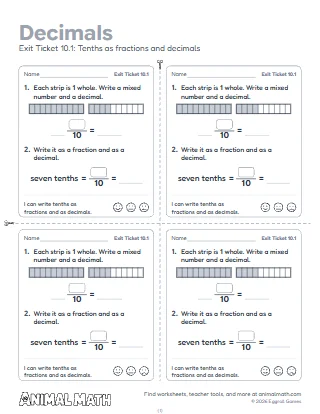
Day 10110.1 Tenths as fractions and decimalsI can write tenths as fractions and as decimals.
Day 10210.2 Hundredths and tenths as hundredthsI can write hundredths as decimals.
Day 10310.3 Add tenths and hundredthsI can add tenths and hundredths.
Day 10410.4 Decimal place valueI can use place value to read and write decimals.
Day 10510.5 Decimals on a number lineI can read and mark decimals on a number line.
Week 22
Day 10610.6 Money as decimalsI can write money as a decimal of a dollar.
Day 10710.7 Compare and order decimalsI can compare and order decimals.
Day 10810.8 Halves, fourths and fifths as decimals ★I can write halves, fourths and fifths as decimals.
Day 10910.9 Thousandths ★I can read, write and compare thousandths.
Day 11010.10 Add and subtract decimals ★I can add and subtract decimals.
Week 23
Day 111Unit ReviewThe review, to go over together.
Day 112Unit TestForm A; Form B (other numbers) is for a retest.
Unit 11

Measurement and Conversions

Weeks 23–25 · 13 days

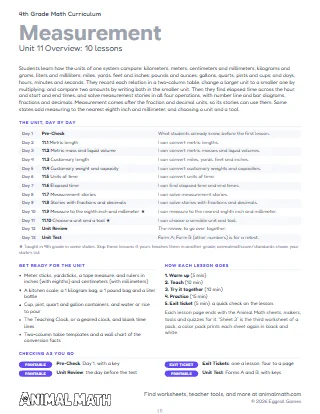
Students learn how the units of one system compare: kilometers, meters, centimeters and millimeters; kilograms and grams; liters and milliliters; miles, yards, feet and inches; pounds and ounces; gallons, quarts, pints and cups; and days, hours, minutes and seconds. They record each relation in a two-column table, change a larger unit to a smaller one by multiplying, and compare two amounts by writing both in the smaller unit. Then they find elapsed time across the hour, and start and end times, and solve measurement stories in all four operations, with number line and bar diagrams, fractions and decimals. Measurement comes after the fraction and decimal units, so its stories can use them. Some states add measuring to the nearest eighth inch and millimeter, and choosing a unit and a tool.

Week 23 (continued)
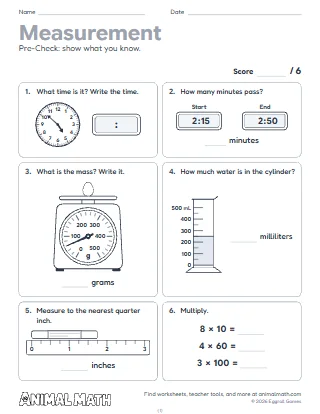
Day 113Pre-CheckWhat students already know, before the unit.
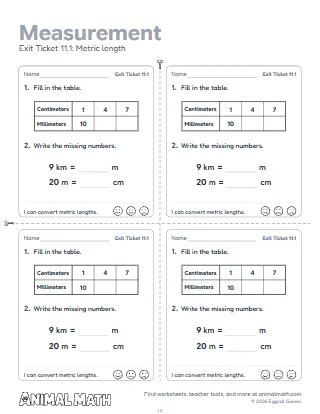
Day 11411.1 Metric lengthI can convert metric lengths.
Day 11511.2 Metric mass and liquid volumeI can convert metric masses and liquid volumes.
Week 24
Day 11611.3 Customary lengthI can convert miles, yards, feet and inches.
Day 11711.4 Customary weight and capacityI can convert customary weights and capacities.
Day 11811.5 Units of timeI can convert units of time.
Day 11911.6 Elapsed timeI can find elapsed time and end times.
Day 12011.7 Measurement storiesI can solve measurement stories.
Week 25
Day 12111.8 Stories with fractions and decimalsI can solve stories with fractions and decimals.
Day 12211.9 Measure to the eighth inch and millimeter ★I can measure to the nearest eighth inch and millimeter.
Day 12311.10 Choose a unit and a tool ★I can choose a sensible unit and tool.
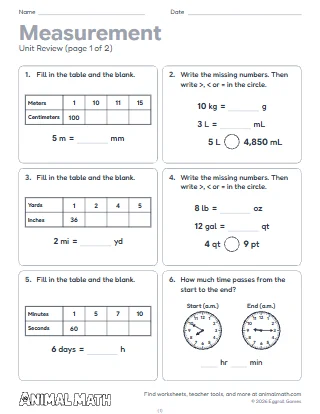
Day 124Unit ReviewThe review, to go over together.
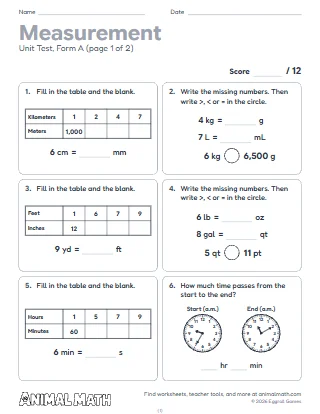
Day 125Unit TestForm A; Form B (other numbers) is for a retest.
Unit 12

Area and Perimeter

Weeks 26–27 · 10 days

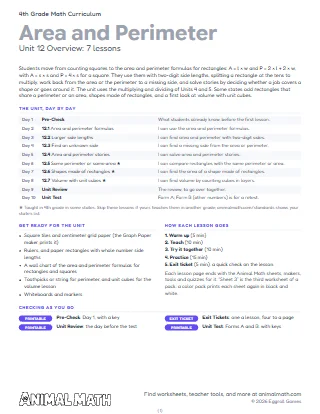
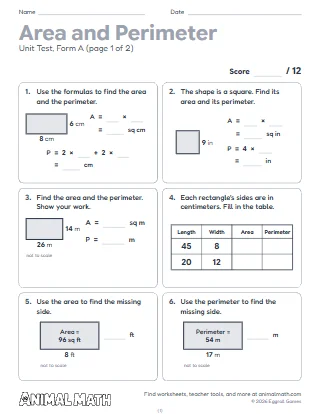
Students move from counting squares to the area and perimeter formulas for rectangles: A = l × w and P = 2 × l + 2 × w, with A = s × s and P = 4 × s for a square. They use them with two-digit side lengths, splitting a rectangle at the tens to multiply, work back from the area or the perimeter to a missing side, and solve stories by deciding whether a job covers a shape or goes around it. The unit uses the multiplying and dividing of Units 4 and 5. Some states add rectangles that share a perimeter or an area, shapes made of rectangles, and a first look at volume with unit cubes.

Week 26
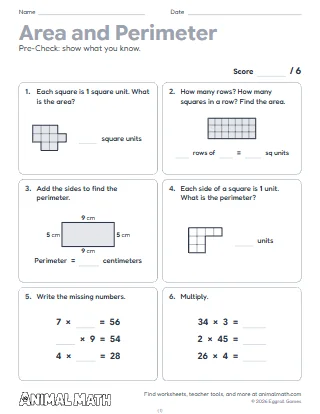
Day 126Pre-CheckWhat students already know, before the unit.
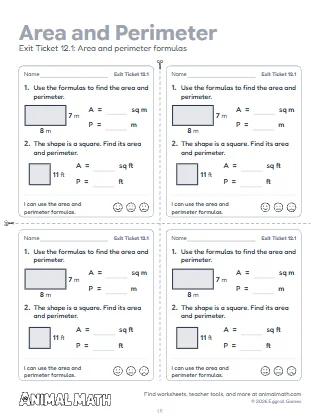
Day 12712.1 Area and perimeter formulasI can use the area and perimeter formulas.
Day 12812.2 Larger side lengthsI can find area and perimeter with two-digit sides.
Day 12912.3 Find an unknown sideI can find a missing side from the area or perimeter.
Day 13012.4 Area and perimeter storiesI can solve area and perimeter stories.
Week 27
Day 13112.5 Same perimeter or same area ★I can compare rectangles with the same perimeter or area.
Day 13212.6 Shapes made of rectangles ★I can find the area of a shape made of rectangles.
Day 13312.7 Volume with unit cubes ★I can find volume by counting cubes in layers.
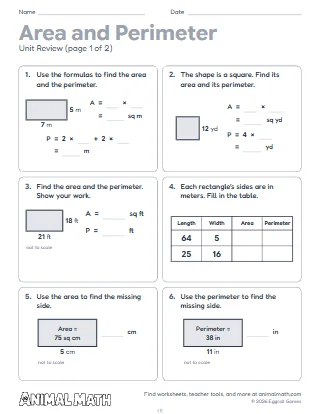
Day 134Unit ReviewThe review, to go over together.
Day 135Unit TestForm A; Form B (other numbers) is for a retest.
Unit 13

Data and Probability

Weeks 28–30 · 11 days

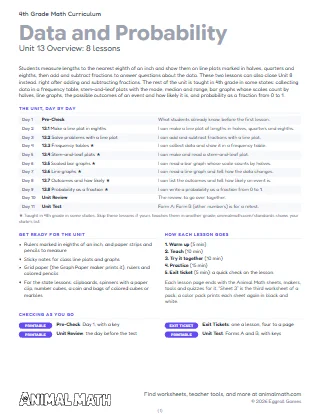
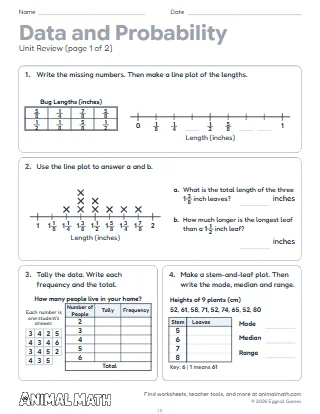
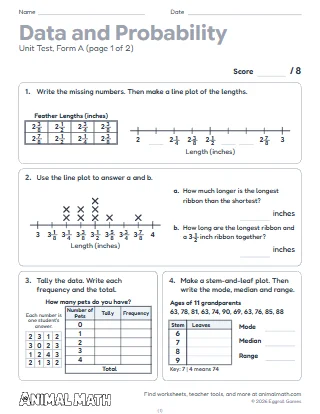
Students measure lengths to the nearest eighth of an inch and show them on line plots marked in halves, quarters and eighths, then add and subtract fractions to answer questions about the data. These two lessons can also close Unit 8 instead, right after adding and subtracting fractions. The rest of the unit is taught in 4th grade in some states: collecting data in a frequency table, stem-and-leaf plots with the mode, median and range, bar graphs whose scales count by halves, line graphs, the possible outcomes of an event and how likely it is, and probability as a fraction from 0 to 1.

Week 28
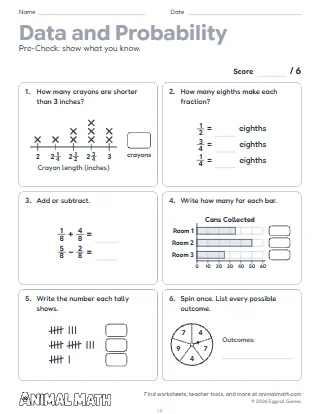
Day 136Pre-CheckWhat students already know, before the unit.
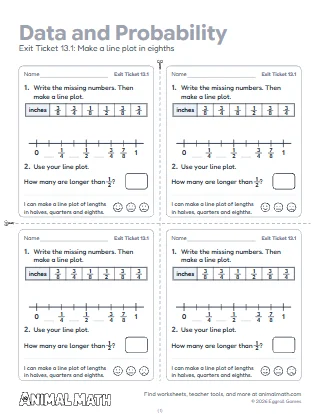
Day 13713.1 Make a line plot in eighthsI can make a line plot of lengths in halves, quarters and eighths.
Day 13813.2 Solve problems with a line plotI can add and subtract fractions with a line plot.
Day 13913.3 Frequency tables ★I can collect data and show it in a frequency table.
Day 14013.4 Stem-and-leaf plots ★I can make and read a stem-and-leaf plot.
Week 29
Day 14113.5 Scaled bar graphs ★I can read a bar graph whose scale counts by halves.
Day 14213.6 Line graphs ★I can read a line graph and tell how the data changes.
Day 14313.7 Outcomes and how likely ★I can list the outcomes and tell how likely an event is.
Day 14413.8 Probability as a fraction ★I can write a probability as a fraction from 0 to 1.
Day 145Unit ReviewThe review, to go over together.
Week 30
Day 146Unit TestForm A; Form B (other numbers) is for a retest.
Unit 14

Lines, Angles and Shapes

Weeks 30–33 · 15 days

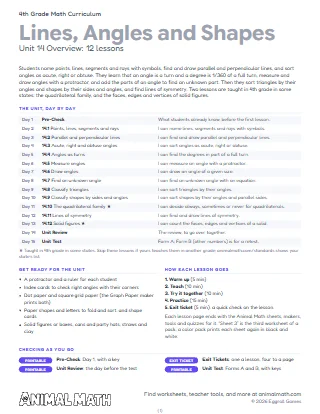
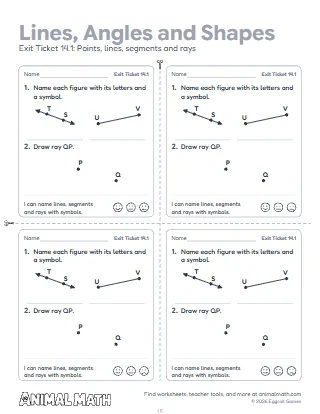
Students name points, lines, segments and rays with symbols, find and draw parallel and perpendicular lines, and sort angles as acute, right or obtuse. They learn that an angle is a turn and a degree is 1/360 of a full turn, measure and draw angles with a protractor, and add the parts of an angle to find an unknown part. Then they sort triangles by their angles and shapes by their sides and angles, and find lines of symmetry. Two lessons are taught in 4th grade in some states: the quadrilateral family, and the faces, edges and vertices of solid figures.

Week 30 (continued)
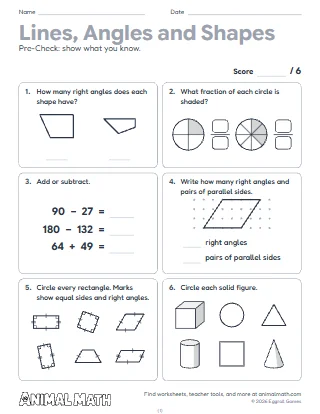
Day 147Pre-CheckWhat students already know, before the unit.
Day 14814.1 Points, lines, segments and raysI can name lines, segments and rays with symbols.
Day 14914.2 Parallel and perpendicular linesI can find and draw parallel and perpendicular lines.
Day 15014.3 Acute, right and obtuse anglesI can sort angles as acute, right or obtuse.
Week 31
Day 15114.4 Angles as turnsI can find the degrees in part of a full turn.
Day 15214.5 Measure anglesI can measure an angle with a protractor.
Day 15314.6 Draw anglesI can draw an angle of a given size.
Day 15414.7 Find an unknown angleI can find an unknown angle with an equation.
Day 15514.8 Classify trianglesI can sort triangles by their angles.
Week 32
Day 15614.9 Classify shapes by sides and anglesI can sort shapes by their angles and parallel sides.
Day 15714.10 The quadrilateral family ★I can decide always, sometimes or never for quadrilaterals.
Day 15814.11 Lines of symmetryI can find and draw lines of symmetry.
Day 15914.12 Solid figures ★I can count the faces, edges and vertices of a solid.
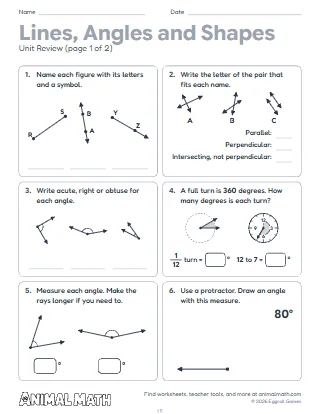
Day 160Unit ReviewThe review, to go over together.
Week 33
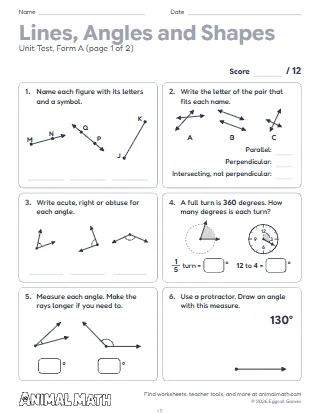
Day 161Unit TestForm A; Form B (other numbers) is for a retest.
Unit 15 ★

Money and Financial Literacy

Weeks 33–35 · 11 days

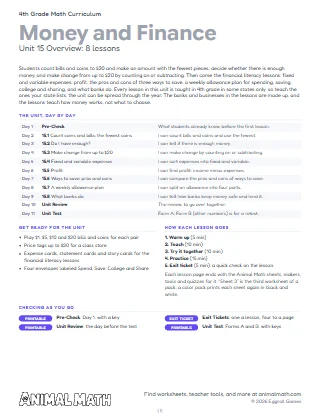
Students count bills and coins to $20 and make an amount with the fewest pieces, decide whether there is enough money, and make change from up to $20 by counting on or subtracting. Then come the financial literacy lessons: fixed and variable expenses, profit, the pros and cons of three ways to save, a weekly allowance plan for spending, saving, college and sharing, and what banks do. Every lesson in this unit is taught in 4th grade in some states only, so teach the ones your state lists; the unit can be spread through the year. The banks and businesses in the lessons are made up, and the lessons teach how money works, not what to choose.

Week 33 (continued)
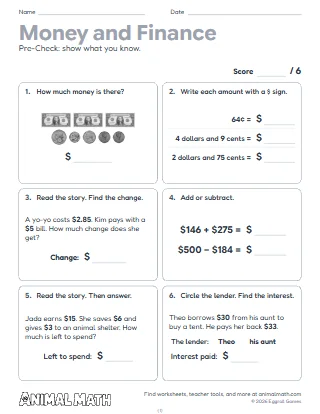
Day 162Pre-CheckWhat students already know, before the unit.
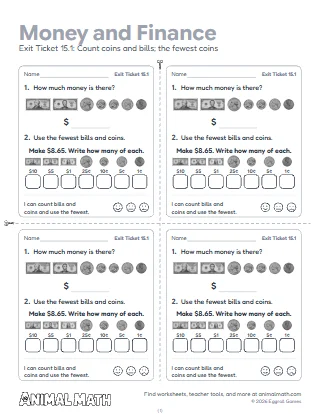
Day 16315.1 Count coins and bills; the fewest coinsI can count bills and coins and use the fewest.
Day 16415.2 Do I have enough?I can tell if there is enough money.
Day 16515.3 Make change from up to $20I can make change by counting on or subtracting.
Week 34
Day 16615.4 Fixed and variable expensesI can sort expenses into fixed and variable.
Day 16715.5 ProfitI can find profit: income minus expenses.
Day 16815.6 Ways to save: pros and consI can compare the pros and cons of ways to save.
Day 16915.7 A weekly allowance planI can split an allowance into four parts.
Day 17015.8 What banks doI can tell how banks keep money safe and lend it.
Week 35
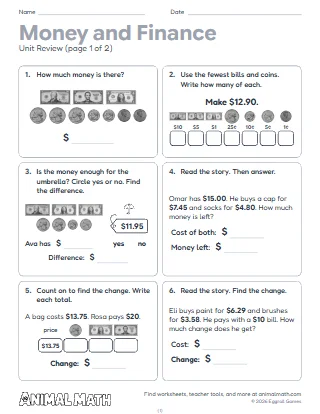
Day 171Unit ReviewThe review, to go over together.
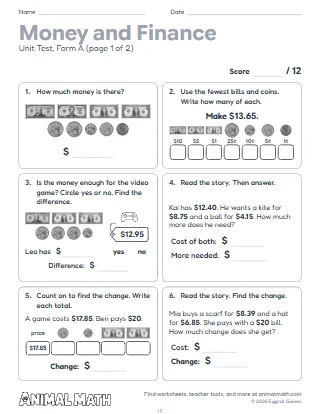
Day 172Unit TestForm A; Form B (other numbers) is for a retest.

Lessons marked ★ are taught in 4th grade in some states and in other grades elsewhere; skip them if your state does not teach them in 4th grade (without them and Unit 15 the year is 93 lessons, which leaves time to spend two days on the multiplication, division and fraction lessons). The two line plot lessons that open Unit 13 can close Unit 8 instead, after adding and subtracting fractions. Unit 15 (money and financial literacy) is for the states that teach it in 4th grade, and it can be spread through the year.

Teaching a grade we don’t cover yet?

Tell us which grade you want a curriculum for next.

Suggest a curriculum

A free curriculum

Every lesson plan, exit ticket and unit test here is free to download and print for your classroom or your home school. You do not need an account, and the PDFs have no watermarks.