Loading preview...

Features

  • Forms A and B ask the same questions with different numbers
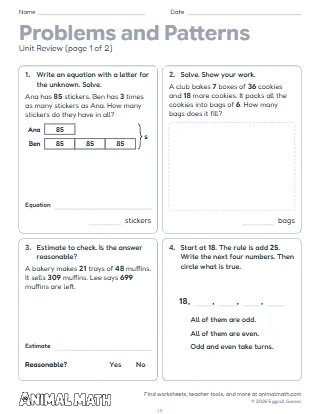
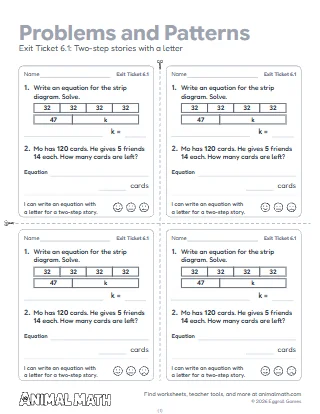
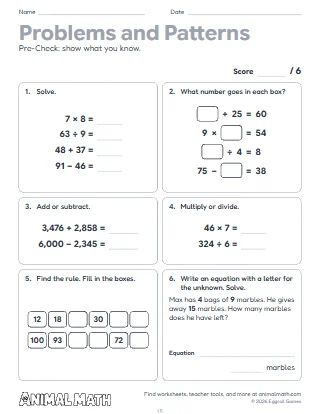
  • Write an equation with a letter for a two-step story shown in a strip diagram
  • Solve a story in three steps with all four operations
  • Estimate to decide whether an answer to a story is reasonable
  • Extend a number pattern from a rule and tell whether its numbers are odd, even or both
  • Fill in a pattern and write its rule, and draw the next step of a shape pattern
  • The last four questions (= and ≠, a letter in any place, input-output tables, rules by position) are for the states that teach them
  • Answer keys name the lesson and skill of every question

Skills Covered

  • Two-step stories with a strip diagram and a letter
  • Multi-step stories with all four operations
  • Estimate to check an answer
  • Number patterns from a rule
  • What a rule does not say: odd and even
  • Shape patterns from a rule
  • True or false with = and ≠
  • A letter in any place of an equation
  • Input-output tables
  • Rules by position

How to Use This Pack

The unit test for the sixth unit of 4th grade, multi-step problems, equations and patterns. Pages 1 and 2 are Form A. Pages 3 and 4 are Form B: the same questions in the same order with different numbers, for a retake, a make-up or a second seating. Each form has 10 questions, one point each, and a Score line on its first page. Questions 7 to 10 (= and ≠, a letter in any place, input-output tables and rules by position) are for the states that teach them in this unit.

In the Classroom

Give Form A the day after the unit review. The keys write one equation for each story and one estimate; any equation that fits the story is right, any letter will do, and an estimate rounded another sensible way is fine. Several questions hold more than one part (questions 7 and 8 have four rows each): give the point when all are right, or score them by the part if you like. Leave out questions 7 to 10 if your class does not learn them and score out of 6. The answer keys name each question's skill, so a missed question points to the lesson to reteach.

At Home

Use Form B as a check after the unit. When your child solves a story, ask what the letter stands for and whether the answer makes sense next to a quick estimate.

Tips for Success

  • Say what the letter stands for before writing the equation
  • In a multi-step story, the answer to one step is a number in the next
  • Round each number to estimate, then compare the estimate with the answer
  • Adding an even number keeps odd numbers odd; adding an odd number makes odd and even take turns
  • Use Form B as a retake after reteaching what was missed

Common Core Standards Alignment

This pack supports the following Common Core State Standards for Mathematics:

  • 3.OA.A.4 Solve for the missing number in multiplying or dividing equations, such as 7 × ? = 42 or ? ÷ 3 = 6.
  • 4.OA.A.3 Solve multi-step story problems with whole numbers and all four operations, deciding what remainders mean, writing equations with a letter, and checking by estimating.
  • 4.OA.C.5 Make a number or shape pattern from a rule and notice features the rule does not say, such as terms switching between odd and even.

© Copyright 2010. National Governors Association Center for Best Practices and Council of Chief State School Officers. All rights reserved.

4th Grade Multi-Step Problems and Patterns Test

The unit test on multi-step story problems, equations and patterns in two forms, from strip diagrams to rules by position. Students write equations with a letter for the unknown, solve and check multi-step stories, extend number and shape patterns from a rule and find the rule of a table.

Download PDF
Pin

What’s Included

  • The unit test in two forms, A and B (10 questions each)
  • Answer keys that name each question's lesson and skill (8 pages in all)
Can’t find what you need?

Tell us what to make next, or build your own with a worksheet maker.

Suggest a worksheet

Free to print and share

This worksheet is free to download, print, copy, and hand out in your classroom or at home. You do not need to create an account, and there are no watermarks on the PDF.