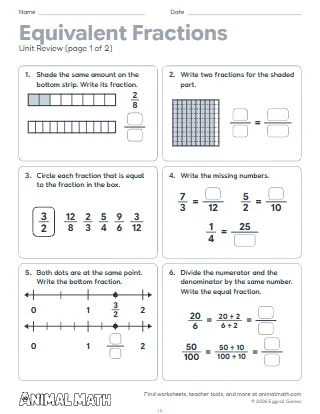
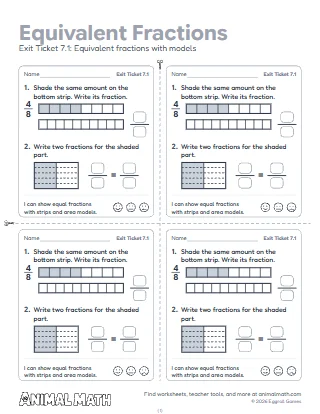
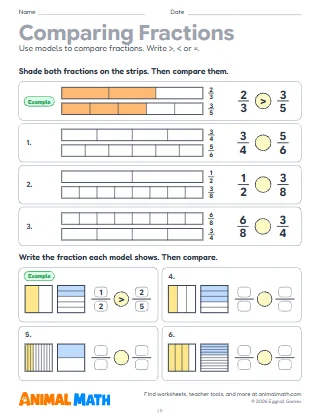
The unit test on equivalent and comparing fractions. Pages 1 and 2 are Form A. Pages 3 and 4 are Form B: the same questions in the same order with different fractions, for a retake, a make-up or a second seating. Each form has 11 questions, one point each, and a Score line on its first page. The fractions use the 4th grade denominators 2, 3, 4, 5, 6, 8, 10, 12 and 100. The pre-check and the unit review are packs of their own.
Give Form A the day after the unit review. Questions 1 to 5 are about making equal fractions: with strips and an area model, by multiplying, on two number lines and by dividing. Questions 6 to 11 compare and order. Question 11 shows two pans of different sizes: the right answer is No, because fractions can only be compared when the wholes are the same size. The answer keys name each question's skill, so a missed question points to the lesson to reteach.
Use Form B as a check after the unit. Ask your child to show you why 3/4 = 9/12 by cutting each fourth of a paper strip into 3 equal parts.
This pack supports the following Common Core State Standards for Mathematics:
© Copyright 2010. National Governors Association Center for Best Practices and Council of Chief State School Officers. All rights reserved.
The unit test on equivalent fractions and comparing fractions, in two forms. Students make equal fractions with models, by multiplying and by dividing, then compare and order fractions and mixed numbers with common denominators, common numerators and benchmarks.
Tell us what to make next, or build your own with a worksheet maker.
This worksheet is free to download, print, copy, and hand out in your classroom or at home. You do not need to create an account, and there are no watermarks on the PDF.