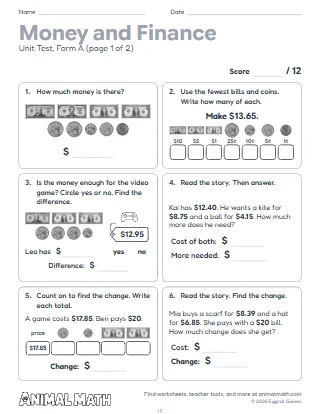
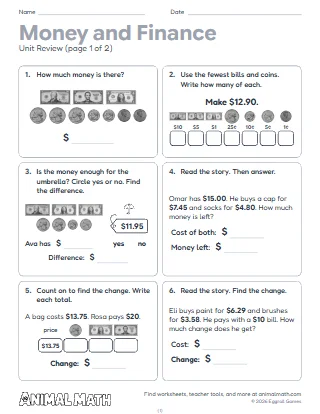
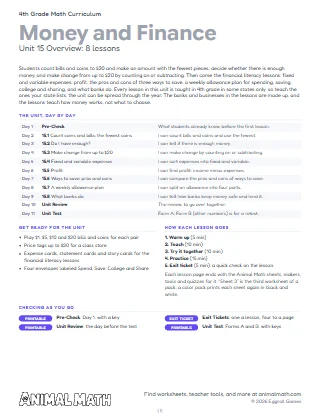
Eight exit tickets, one for each lesson of the 4th grade money and financial literacy unit, in lesson order. Each page holds one lesson's ticket four times: copy the page, cut on the dashed lines, and seven copies give a class of 28 a ticket each. A ticket takes a few minutes at the end of the lesson. Students answer two quick questions, then circle a face beside the lesson's "I can" line to show how sure they feel. Coins and bills are drawn from real money pictures, coins at their true sizes next to each other.
Hand out the tickets in the last five minutes of the lesson and collect them at the door. Sort them into three piles (got it, almost, not yet) to plan tomorrow's small groups. Every lesson in this unit comes from state standards: tickets 15.1 and 15.2 (counting money, the fewest bills and coins, enough money) are taught in 4th grade in Oklahoma and South Carolina, ticket 15.3 (making change from up to $20) in Florida and Oklahoma, and tickets 15.4 to 15.8 are the Texas financial literacy lessons; use the ones your class learns. Every amount of bills and coins is $20.00 or less. The unit test is a separate pack and asks none of these problems.
Use a ticket as a quick check after practicing a skill together. Pay for something with a $10 or $20 bill and count on to check the change, and talk about which family bills stay the same each month and which change.
This pack supports the following Common Core State Standards for Mathematics:
© Copyright 2010. National Governors Association Center for Best Practices and Council of Chief State School Officers. All rights reserved.
Exit tickets for every lesson of a unit on money and financial literacy. Each page holds one ticket four times to cut apart, with questions on bills and coins, enough money, making change, expenses, profit, ways to save, an allowance and what banks do.
Tell us what to make next, or build your own with a worksheet maker.
This worksheet is free to download, print, copy, and hand out in your classroom or at home. You do not need to create an account, and there are no watermarks on the PDF.