Loading preview...

Features

  • Forms A and B ask the same questions with different figures and numbers
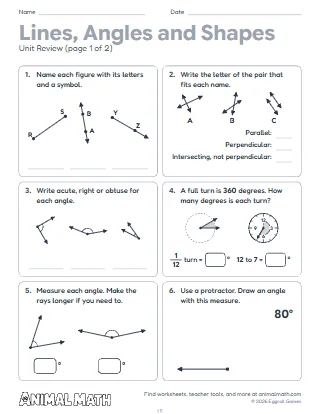
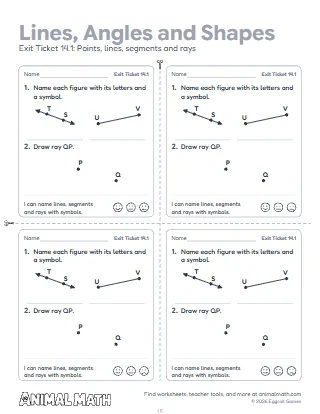
  • Name a line, a ray and a line segment with symbols, and tell parallel, perpendicular and intersecting lines apart
  • Sort angles as acute, right or obtuse, and find the degrees in part of a turn and in a clock's minute hand
  • Measure an acute and an obtuse angle and draw an angle with a protractor, every angle a whole number of degrees at true size
  • Write an equation to find an unknown angle on a straight line
  • Sort triangles by their angles, mark the right angles and parallel sides of a shape on dot paper, and draw lines of symmetry
  • The last two questions are for the states that teach them in 4th grade: always, sometimes or never in the quadrilateral family, and the faces, edges and vertices of a solid
  • Answer keys name the lesson and skill of every question

Skills Covered

  • Name lines, rays and line segments with symbols
  • Parallel, perpendicular and intersecting lines
  • Acute, right and obtuse angles
  • Angles as turns of a circle
  • Measure and draw angles with a protractor
  • Find an unknown angle with an equation
  • Classify triangles by their angles
  • Right angles and parallel sides of shapes, marked
  • Lines of symmetry
  • Always, sometimes or never in the quadrilateral family
  • Faces, edges and vertices of solids

How to Use This Pack

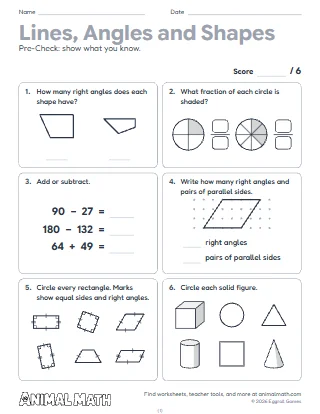
The unit test on lines, angles and shapes. Pages 1 and 2 are Form A. Pages 3 and 4 are Form B: the same questions in the same order with different figures and numbers, for a retake, a make-up or a second seating. Each form has 12 questions, one point each, and a Score line on its first page. Questions 1 to 10 are the Common Core part of the unit; questions 11 and 12 (always, sometimes or never, and the faces, edges and vertices of a solid) are for the states that teach them. The pre-check and the unit review are packs of their own.

In the Classroom

Each student needs a protractor for questions 5 and 6. Every angle is a whole number of degrees and is drawn at its true size, so it measures right even when the page is copied smaller or larger. Give Form A the day after the unit review. Questions 11 and 12 are taught in 4th grade in some states only: the quadrilateral family (Indiana, Oklahoma, South Carolina, Virginia) and solid figures (Oklahoma, Virginia). A class that follows the Common Core can stop after question 10 and score out of 10. Most questions have two or three parts (three figures, two turns, two angles to measure): give the point when every part is right, or split it among the parts. The answer keys name each question's skill, so a missed question points to the lesson to reteach.

At Home

Use Form B as a check after the unit. Look for parallel and perpendicular lines and right, acute and obtuse angles around the house, and open a door a quarter turn, then a half turn.

Tips for Success

  • Have a protractor for every student, and show how to line up its center and its zero
  • Ask "is it more or less than a right angle?" before reading a protractor's scale
  • A ray is named from its endpoint, so its letters go only one way
  • Go over the unit review the day before the test
  • Use Form B as a retake after reteaching what was missed

Common Core Standards Alignment

This pack supports the following Common Core State Standards for Mathematics:

  • 3.G.A.1 See that shapes like rhombuses, rectangles and squares share features, such as four sides, that make them all quadrilaterals; draw quadrilaterals outside those groups.
  • 4.MD.C.5a Know an angle's size is the share of a circle (centered at its vertex) between its rays; one degree is 1/360 of a full turn.
  • 4.MD.C.5b Know that an angle made of some number of one-degree turns measures that many degrees, so 50 one-degree turns make 50°.
  • 4.MD.C.6 Use a protractor to find the size of an angle to the nearest whole degree, and draw angles of a given size.
  • 4.MD.C.7 Know that angle measures add up when an angle is split into parts, and find unknown angles in diagrams by adding or subtracting, using equations.
  • 4.G.A.1 Draw and find points, lines, line segments, rays, right, acute and obtuse angles, and parallel and perpendicular lines, including in flat shapes.
  • 4.G.A.2 Sort flat shapes by whether they have parallel or perpendicular lines or angles of a certain size, and recognize right triangles as a group.
  • 4.G.A.3 Find a line of symmetry, a fold line that makes two matching parts; pick out shapes that have one and draw their lines of symmetry.

© Copyright 2010. National Governors Association Center for Best Practices and Council of Chief State School Officers. All rights reserved.

4th Grade Lines, Angles and Shapes Test

The unit test on lines, angles and shapes, in two forms, A and B. Students name lines, rays and segments, measure and draw angles with a protractor, find an unknown angle, sort triangles and shapes by their angles and sides, and draw lines of symmetry.

Download PDF
Pin

What’s Included

  • The unit test in two forms, A and B (12 questions each)
  • Answer keys that name each question's lesson and skill (8 pages in all)
Can’t find what you need?

Tell us what to make next, or build your own with a worksheet maker.

Suggest a worksheet

Free to print and share

This worksheet is free to download, print, copy, and hand out in your classroom or at home. You do not need to create an account, and there are no watermarks on the PDF.