Loading preview...

Features

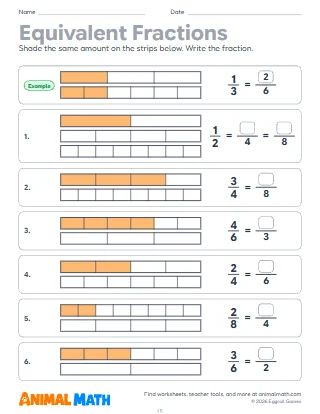
  • Shade fraction strips to twelfths, like 6/8 = 9/12
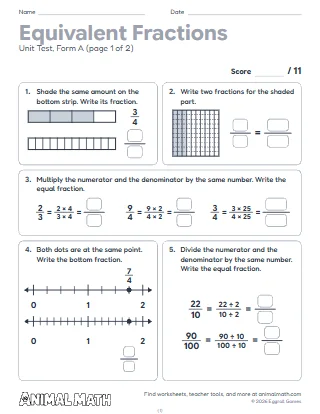
  • Cut area models and hundredths grids into more equal parts: 2/5 = (2 × 20)/(5 × 20)
  • Multiply the numerator and denominator by the same number, to twelfths, tenths and hundredths
  • Find missing numerators and denominators, and spot fractions that are not equal
  • Label number lines past 1 and find the fractions at the same point
  • Divide to find equal fractions and write fractions in simplest form
  • Every page in color and in black and white
  • Answer keys included

Skills Covered

  • Show equal fractions with strips, area models and hundredths grids
  • Explain why multiplying the numerator and denominator by the same number makes an equal fraction
  • Find equal fractions at the same point on number lines, past 1 too
  • Find a missing numerator or denominator
  • Divide the numerator and denominator by the same number
  • Write a fraction in simplest form

How to Use This Pack

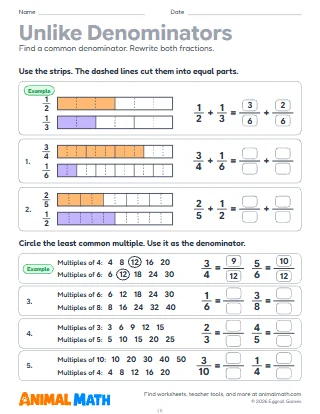
Five pages on equivalent fractions with denominators 2, 3, 4, 5, 6, 8, 10, 12 and 100. On page 1 the top strip shows a fraction, and students shade the same length on the strips below it and write their fractions, like 6/8 = 9/12 and 6/12 = 2/4 = 1/2. Page 2 cuts every part of a rectangle into rows, so 3/4 becomes (3 × 3)/(4 × 3) = 9/12, then cuts tenths, fifths and halves on 10 by 10 grids into hundredths. Page 3 multiplies with no model: finding the number to multiply by, missing numerators and denominators (some past 1, like 9/4 = 27/12), and deciding whether pairs like 2/3 and 5/6 are equal. Page 4 labels number lines in sixths and twelfths, in thirds and sixths from 0 to 2, and in fifths and tenths from 1 to 2, and writes the fractions at the same point. Page 5 divides to find equal fractions (80/100 = 8/10), writes fractions in simplest form, and finds two more fractions equal to a given one.

In the Classroom

Before page 2, fold a paper strip into thirds and shade 2 parts, then fold it in half the other way: there are now 6 parts, and 4 are shaded. Ask what happened to the number of parts and to the number of shaded parts. Each part was cut into 2, so both numbers doubled, while the shaded amount stayed the same: cutting every part into 2 is the same as taking 2/2 of each part, and 2/2 = 1. On page 4, lay the two number lines side by side on the board and have students point to fractions that land on the same mark.

At Home

Cut a sandwich into 4 equal pieces and eat 1. Then cut every piece in half: how many pieces are there now, and how many were eaten? Write both fractions, 1/4 = 2/8. A dollar works too: 1/4 of a dollar is 25 cents, or 25/100 of a dollar.

Tips for Success

  • Equal fractions name the same amount of the same whole
  • Cutting every part into n smaller parts makes n times as many parts, and n times as many shaded: (n × a)/(n × b)
  • n/n = 1, so multiplying the numerator and denominator by n does not change the amount
  • Dividing the numerator and denominator by the same number also makes an equal fraction
  • A fraction is in simplest form when no number but 1 divides both the numerator and the denominator

Common Core Standards Alignment

This pack supports the following Common Core State Standards for Mathematics:

  • 3.NF.A.2a Mark 1/b on a number line by splitting the space from 0 to 1 into b equal parts; the first part ends at 1/b.
  • 3.NF.A.2b Place a/b on a number line by counting a jumps of size 1/b from 0; where the jumps end is a/b.
  • 4.NF.A.1 Explain with fraction models why multiplying a fraction's numerator and denominator by the same number gives an equal fraction; use this to find equivalent fractions.
  • 4.NF.C.5 Rewrite tenths as hundredths, such as 7/10 = 70/100, to add a fraction in tenths to one in hundredths.

© Copyright 2010. National Governors Association Center for Best Practices and Council of Chief State School Officers. All rights reserved.

Equivalent Fractions for 4th Grade

4th Grade

Equivalent fractions with fifths, tenths, twelfths and hundredths, and fractions greater than 1. Students shade strips, cut area models and hundredths grids, label number lines, and multiply or divide the numerator and denominator by the same number to find equal fractions.

Download PDF
Pin

What’s Included

  • 5 worksheets in color and in black and white, with answer keys (15 pages)
  • Fraction strips, area models and hundredths grids
  • Multiplying and dividing the numerator and denominator, with missing numbers
  • Number lines past 1, simplest form, and finding more equal fractions
Can’t find what you need?

Tell us what to make next, or build your own with a worksheet maker.

Suggest a worksheet

Free to print and share

This worksheet is free to download, print, copy, and hand out in your classroom or at home. You do not need to create an account, and there are no watermarks on the PDF.