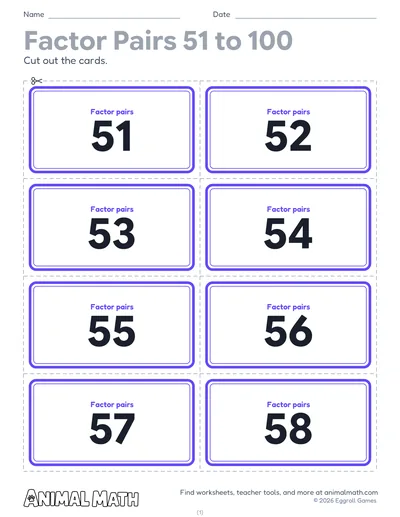
Fifty flash cards, eight to a sheet, one for every number from 1 to 50. Each front shows the number under the words "Factor pairs"; its back shows every factor pair, smallest first and lined up on the × sign (1 × 24, 2 × 12, 3 × 8, 4 × 6), then all the factors in a list. A prime number has only the pair 1 × itself and is marked "prime". Print the pack double-sided and flip on the long edge: each back sheet is laid out mirrored, so every card's back lands behind its front. On a printer that prints one side, choose Fronts only under Print, put the printed sheets back in the paper tray, then choose Backs only. Fronts have a thick frame and backs a thin one, so a card turned the wrong way stands out.
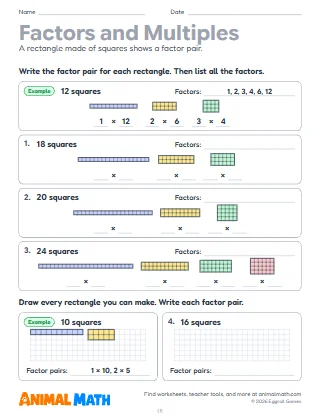
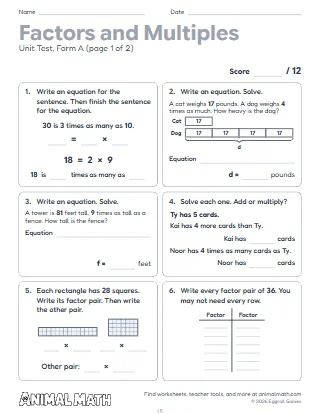
Give partners a pile of cards and a whiteboard: one turns over a front, both write the factor pairs, and the card is flipped to check who found them all. Sort the cards into prime and composite piles. Ask why the pairs stop where they do: once the first factor passes the second, every pair has been found.
Try two or three numbers a day. Start at 1 × the number and count up through 2, 3, 4 and so on, asking each time whether that number goes in evenly.
This pack supports the following Common Core State Standards for Mathematics:
© Copyright 2010. National Governors Association Center for Best Practices and Council of Chief State School Officers. All rights reserved.
Flash cards for the factor pairs of the numbers 1 to 50, with the number on the front and its factor pairs and factors on the back. Students find every factor pair of a number, then turn the card over to check and see whether it is prime or composite.
Tell us what to make next, or build your own with a worksheet maker.
This worksheet is free to download, print, copy, and hand out in your classroom or at home. You do not need to create an account, and there are no watermarks on the PDF.