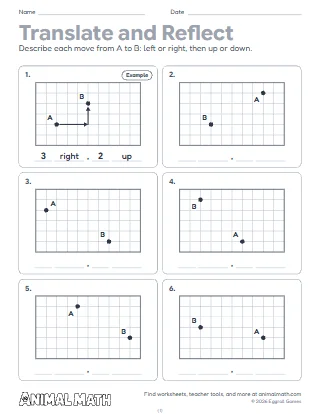
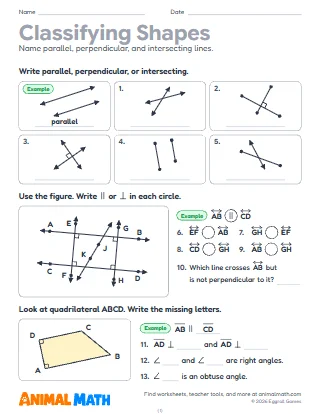
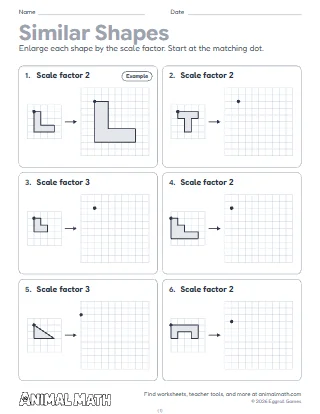
Five pages for Year 6 on the full coordinate grid, with the x-axis and the y-axis crossing at the origin. Page 1 asks children to read the coordinates of ten points spread over all four quadrants. Page 2 works the other way: children plot and label ten points from their coordinates. Page 3 gives three corners of a rectangle or square, one of them tilted, and children plot them, find the fourth corner and write its coordinates. Page 4 translates shapes from one quadrant into another, and page 5 reflects shapes in the x-axis or the y-axis; on both, children draw the new shape and write the coordinates of each vertex.
Draw the axes on the board and mark the origin. Walk along the x-axis first, then up or down: "along the corridor, then up the stairs". Ask children what is the same about every point in the bottom left quadrant, and what happens to the coordinates when a point is reflected in the y-axis.
Draw a large grid with both axes on squared paper and take turns calling out coordinates, such as (−4, 3), for the other person to plot. Join the points to make a shape, then reflect it in one of the axes together.
This pack supports the following Common Core State Standards for Mathematics:
© Copyright 2010. National Governors Association Center for Best Practices and Council of Chief State School Officers. All rights reserved.
Reading, plotting and moving points on a coordinate grid with all four quadrants and negative numbers. Students read and plot coordinates such as (−3, 2), find the missing vertex of a rectangle or square, and translate and reflect shapes in the axes, giving the new coordinates of each vertex.
Tell us what to make next, or build your own with a worksheet maker.
This worksheet is free to download, print, copy, and hand out in your classroom or at home. You do not need to create an account, and there are no watermarks on the PDF.