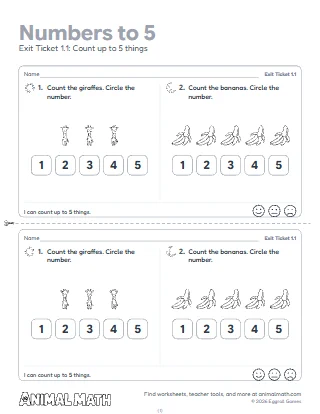
Ten exit tickets, one for each lesson of a Kindergarten unit on numbers to 10, in lesson order. Each page holds one lesson's ticket twice, with room for big Kindergarten writing: copy the page, cut on the dashed line, and fourteen copies give a class of 28 a ticket each. Read each question aloud: a small picture beside the question number (a sun, a moon) lets you say "Find the sun. Count the snakes." Children answer one or two questions, then circle a face beside the "I can" line, which you read to them.
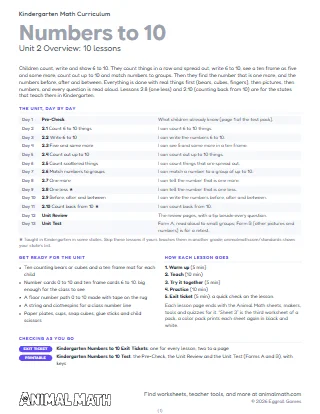
Give the tickets in the last five minutes of the lesson, at a table or on the rug with clipboards. Sort them into three piles (got it, almost, not yet) to plan tomorrow's small groups. Tickets 2.8 (one less) and 2.10 (counting back from 10) are for the states that teach them in Kindergarten. The unit test is a separate pack.
Use a ticket as a quick check after practicing together. Read the question aloud and let your child point and count out loud.
This pack supports the following Common Core State Standards for Mathematics:
© Copyright 2010. National Governors Association Center for Best Practices and Council of Chief State School Officers. All rights reserved.
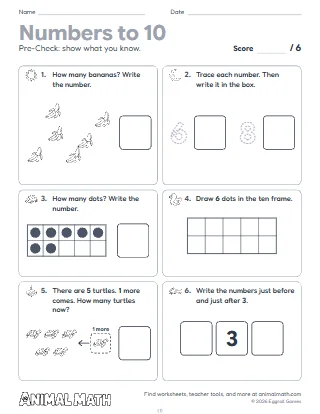
Exit tickets for every lesson of a Kindergarten unit on numbers to 10, made to be read aloud: one page a lesson, with the same ticket twice to copy and cut apart. Each ticket has one or two picture questions, answered by circling, writing one number, drawing dots or drawing a line, and ends with an "I can" line and three faces for children to circle. Children count 6 to 10 things in rows and scattered, trace and write 6 to 10, see 5 and some more in a ten frame, count out up to 10, match groups to numbers, find one more, and write the numbers before, after and between. Tickets 2.8 (one less) and 2.10 (counting back from 10) are for the states that teach them. A small picture beside each question number lets the teacher say "find the sun." Answer keys for every ticket.
Tell us what to make next, or build your own with a worksheet maker.
This worksheet is free to download, print, copy, and hand out in your classroom or at home. You do not need to create an account, and there are no watermarks on the PDF.