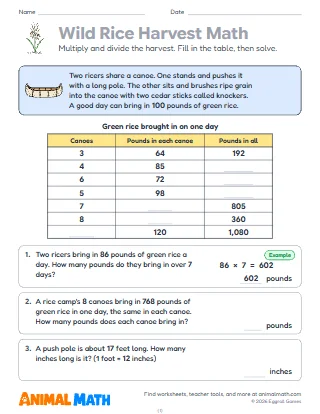
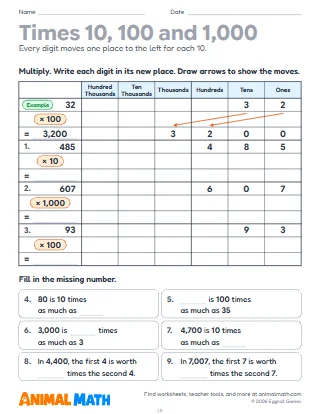
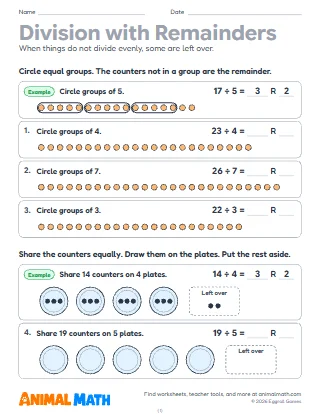
Anishinaabe, Haudenosaunee and other Native nations of the Great Lakes and Northeast made maple syrup and sugar long before Europeans arrived, and taught the settlers how. Families still gather at the sugar bush (iskigamizigan in Ojibwe) in late winter and early spring, when freezing nights and thawing days make the sap run. A slanted cut or a spout in the bark lets sap drip into birchbark containers, and boiling turns it into syrup, then maple sugar, kept in birchbark boxes (makakoon). The Haudenosaunee give thanks to the maple trees in spring as the sap begins to run. The figures on these pages come from park service and university extension guides.
Five pages of 4th grade math from the sugar bush, each starting with a short panel that gives the facts it needs. Page 1 fills in sap to syrup tables at 40 to 1 and 30 to 1, then three stories. Page 2 gives twelve maples by how wide they are: students write each tree's taps, add them up, and find the sap and syrup. Page 3 marks the days the sap runs from a week of temperatures, then reads a bar graph of a week of sap. Page 4 has six boiling stories about elapsed time and temperature. Page 5 fills in a gallons, quarts and cups table and solves four stories; the last asks how many baskets are needed, so the remainder matters. The first tree on page 2 and the first story on page 4 are worked examples.
Read each page's panel together first: it holds the numbers the problems need. Page 2's trees at 11, 12, 18 and 19 inches are the ones to talk about. On page 3, ask why a night above freezing or a day below it stops the sap.
If you have maple syrup at home, read the label together and work out how much sap went into the bottle (a quart of syrup is about 10 gallons of sap).
This pack supports the following Common Core State Standards for Mathematics:
© Copyright 2010. National Governors Association Center for Best Practices and Council of Chief State School Officers. All rights reserved.
Word problems, tables and a graph from the spring sugar bush, where Anishinaabe, Haudenosaunee and other Native nations boil maple sap into syrup and sugar. Students multiply and divide by 40, count taps, read a week of sap, work out boiling times and change gallons to quarts and cups.
Tell us what to make next, or build your own with a worksheet maker.
This worksheet is free to download, print, copy, and hand out in your classroom or at home. You do not need to create an account, and there are no watermarks on the PDF.