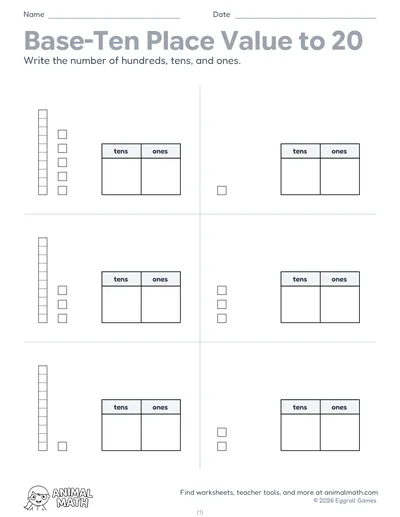
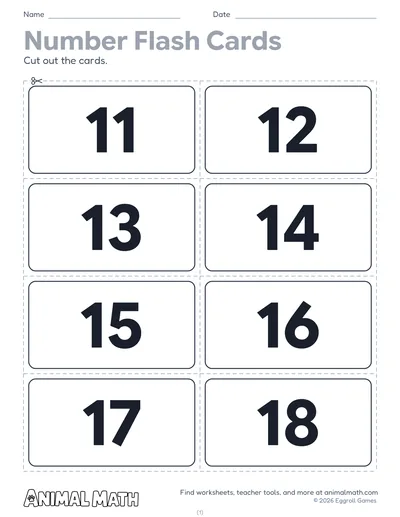
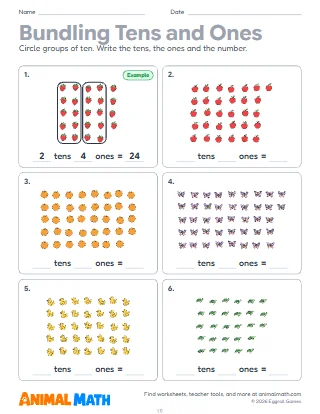
Five pages of matching, five numbers on the left and five pictures of base-ten blocks on the right, in another order. Each page moves up the number line: 11 to 30, 20 to 50, 40 to 70, 60 to 99, and 90 to 120 on the last page, where a hundred flat joins the rods and ones. Ten rods stand side by side and the ones sit in columns of five, so 7 ones read as 5 and 2 more. Numbers with the same two digits are put on the same page, such as 24 and 42, so a child has to count the rods to tell them apart. The answer keys draw the lines in blue.
Count the first picture together: touch each rod and count by tens, then count on the ones. Ask which number on the left matches before drawing the line. When two numbers have the same digits, ask how many rods each one needs. With real base-ten blocks, children can build the number first and then find its picture.
Cover the numbers with a finger and ask your child to count a picture first, then find the number. Bundles of ten straws or craft sticks make good blocks at home.
This pack supports the following Common Core State Standards for Mathematics:
© Copyright 2010. National Governors Association Center for Best Practices and Council of Chief State School Officers. All rights reserved.
Matching numbers to 120 with the same numbers in base-ten blocks. Students count the tens and ones in each picture and draw a line to the number it shows, with look-alikes such as 24 and 42 on one page.
Tell us what to make next, or build your own with a worksheet maker.
This worksheet is free to download, print, copy, and hand out in your classroom or at home. You do not need to create an account, and there are no watermarks on the PDF.