Loading preview...

Features

  • The fraction insets from halves to tenths, each piece with its knob
  • Name the piece lifted out of each frame, from one half to one tenth
  • Count the pieces that make one whole, and the pieces still missing from a frame
  • Write the fraction of the circle in a frame, and color pieces to show a fraction
  • Find the pieces that cover one half, and other equal fractions, with the smaller pieces laid on top
  • Compare unit fractions with > and <, with the pieces and then without
  • Every fraction written stacked
  • Every page in color and in black and white
  • Answer keys included

Skills Covered

  • Name a unit fraction from one half to one tenth
  • Know that n pieces of one nth make one whole
  • Write the fraction of a circle that is shown
  • Find fractions equal to one half: two fourths, three sixths, four eighths, five tenths
  • Find other equal fractions by laying smaller pieces on larger ones
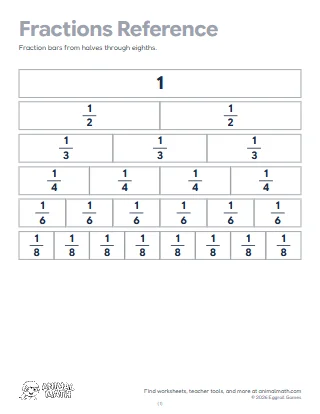
  • Compare unit fractions: the more pieces in the whole, the smaller each one

How to Use This Pack

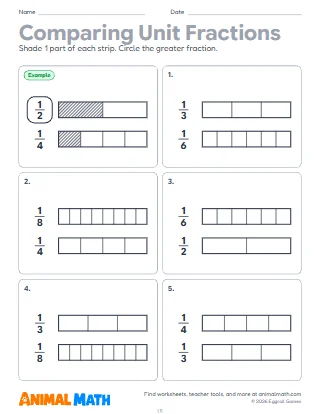
Five pages, in the order the fraction insets are usually presented. Page 1 lifts one piece out of each frame, from halves to tenths, and students write the fraction for that piece. Page 2 pulls the pieces of a circle apart to count how many make one whole, then shows frames with some pieces in: students write how many more make one whole. Page 3 asks for the fraction of the circle in each frame, then gives empty frames to color a fraction. Page 4 is equivalence: the pieces that cover one half, then pairs where dashed lines show smaller pieces laid over larger ones. Page 5 compares unit fractions with > and <, first with pieces from circles of the same size, then with the fractions alone.

In the Classroom

Work with the real fraction insets first. Take the pieces out of a frame, count them, and name them together: one fourth, two fourths, three fourths, four fourths make one whole. Lay the fourths on the half to see that two of them cover it exactly. The worksheet then records the work, and the frames on the page are a quick check: a piece fits only in its own frame.

At Home

Cut paper plates or circles of paper the same size into halves, fourths and eighths, and color each set the same. Ask which pieces cover a half, and which is bigger, one fourth or one eighth. Pizza and pie slices make good examples of the same idea.

Tips for Success

  • Every piece of one circle is the same size, so the pieces name the fraction: 1 of 4 equal pieces is one fourth
  • The number of pieces that make one whole is the bottom number of the fraction
  • Pieces that cover the same space are equal fractions
  • All the circles are the same size, so more pieces means smaller pieces: one tenth is less than one third
  • In black and white, the pieces in a frame are gray and the empty places are dashed

Common Core Standards Alignment

This pack supports the following Common Core State Standards for Mathematics:

  • 2.G.A.3 Cut circles and rectangles into 2, 3 or 4 equal parts called halves, thirds or fourths; equal parts of one whole can look different.
  • 3.NF.A.1 Know 1/b is one of b equal parts of a whole, and a/b is a of those parts (denominators 2, 3, 4, 6 and 8).
  • 3.NF.A.3a Know that two fractions are equal when they cover the same amount of a whole or land at the same spot on a number line.
  • 3.NF.A.3b Find and make simple equal fractions, such as 3/6 = 1/2, and use a picture or model to show why they match.
  • 3.NF.A.3c Show a whole number in fraction form and notice when a fraction names a whole number, such as 2 = 2/1 or 8/4 = 2.
  • 3.NF.A.3d Compare fractions of the same whole that have equal numerators or equal denominators, thinking about part size; record with >, = or < and explain.
  • 3.G.A.2 Divide shapes into parts of equal area and describe each part with a unit fraction, such as 1/6 of the shape.
  • 4.NF.A.1 Explain with fraction models why multiplying a fraction's numerator and denominator by the same number gives an equal fraction; use this to find equivalent fractions.
  • 4.NF.C.5 Rewrite tenths as hundredths, such as 7/10 = 70/100, to add a fraction in tenths to one in hundredths.

© Copyright 2010. National Governors Association Center for Best Practices and Council of Chief State School Officers. All rights reserved.

Montessori Fraction Circles

2nd – 4th Grade

The Montessori fraction insets, red circles cut into halves to tenths in their green frames, drawn as they look on the shelf. Students name a piece, count the pieces that make one whole, write the fraction in a frame, find the pieces that cover one half and compare unit fractions.

Download PDF
Pin

What’s Included

  • 5 worksheets in color and in black and white, with answer keys (15 pages)
  • Name the piece, and the pieces that make one whole
  • Write the fraction in a frame, and color a fraction
  • Equal to one half and other equal fractions, and comparing unit fractions
Can’t find what you need?

Tell us what to make next, or build your own with a worksheet maker.

Suggest a worksheet

Free to print and share

This worksheet is free to download, print, copy, and hand out in your classroom or at home. You do not need to create an account, and there are no watermarks on the PDF.