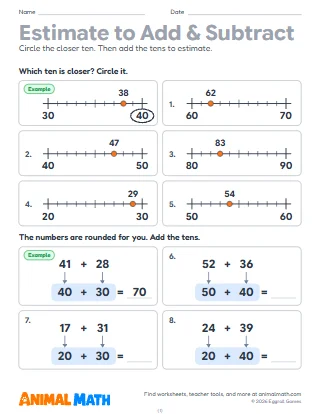
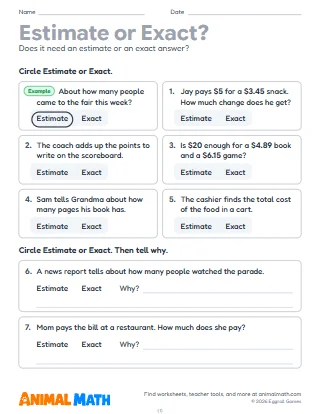
Six pages of story problems that ask about how many or about how much, each with four answers, A to D, as on a multiple choice test. Under every story an Estimate line asks for the two numbers rounded to the nearest ten and the estimate, so students show how they chose. Page 1 is adding and starts with a worked example: 38 red apples and 21 green apples are about 40 + 20 = 60. Page 2 is taking away, page 3 is how many more, how many fewer and a missing part, and page 4 is cents and inches. On page 5 the choices are number sentences: students circle the best way to estimate, then write the estimate. Page 6 mixes every kind. The wrong answers are the tens children get from common mistakes: dropping the ones (30 + 20), rounding one number the wrong way, or adding instead of subtracting.
Do the example on page 1 together: find the two tens each number is between and ask which one is closer, then add the tens. After a page, pick a wrong answer and ask how someone might have got it; most of them come from a real mistake. Page 5 works well as a talk: why is 50 + 30 a better way to estimate 47 + 31 than 40 + 30?
Ask about how much at the store: a juice costs 57 cents and a banana 31 cents, about how much is that? Round each price to the nearest ten and add. Then cover the choices on a problem and ask your child for the estimate first, before looking at A to D.
This pack supports the following Common Core State Standards for Mathematics:
© Copyright 2010. National Governors Association Center for Best Practices and Council of Chief State School Officers. All rights reserved.
Multiple choice word problems that ask about how many or about how much, with numbers up to 100. Students round each number to the nearest ten, estimate the sum or difference and circle the best of four answers.
Tell us what to make next, or build your own with a worksheet maker.
This worksheet is free to download, print, copy, and hand out in your classroom or at home. You do not need to create an account, and there are no watermarks on the PDF.