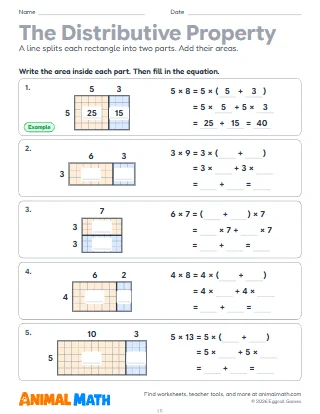
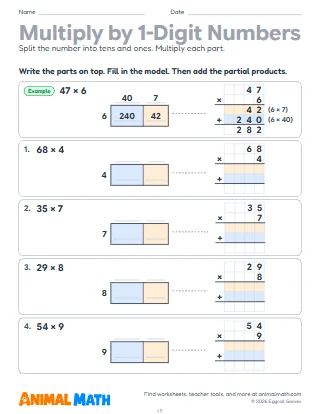
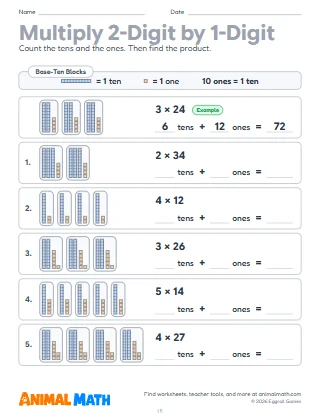
Six pages of area models only, each step a little harder. Page 1 multiplies 2-digit numbers by a one-digit number with the tens and ones already written on top of the model (38 is 30 and 8): students write the area of each part and add. Pages 2 and 3 leave the splitting to the student, with 3-digit and then 4-digit numbers in three and four parts. Page 4 splits both numbers of a 2-digit × 2-digit problem, so the model has four parts, and the partial products are added in a column beside it. Page 5 turns it around: students write the problem a finished model shows, and work out missing sides and parts from the numbers that are there. Page 6 gives two problems and two stories with room to draw a model of their own. Every page starts with a worked example, and each part of a model is colored by its place value.
Work the example on page 1 together and ask why the model is a rectangle split in two: 6 × 38 is 6 rows of 30 and 6 rows of 8. Point out that the color of a part tells its place (6 × 30 = 180 is tens, so it is blue), which helps students line up the parts when they add. Before page 4, draw 32 × 17 on the board and show that each of the four parts is one multiplication fact with zeros.
Draw a rectangle on scrap paper for a multiplication your child is working on and split it along the place values: 4 × 253 becomes 4 × 200, 4 × 50 and 4 × 3. Ask your child to explain what each part means before adding them up.
This pack supports the following Common Core State Standards for Mathematics:
© Copyright 2010. National Governors Association Center for Best Practices and Council of Chief State School Officers. All rights reserved.
Multiplying multi-digit numbers with area models, where each part of a rectangle is one partial product. Students split numbers by place value, find the area of each part, add the parts, read finished models and draw their own.
Tell us what to make next, or build your own with a worksheet maker.
This worksheet is free to download, print, copy, and hand out in your classroom or at home. You do not need to create an account, and there are no watermarks on the PDF.