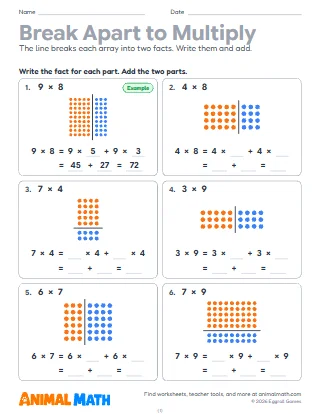
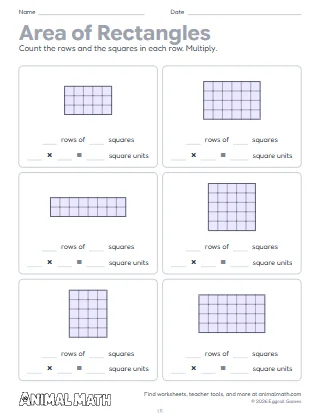
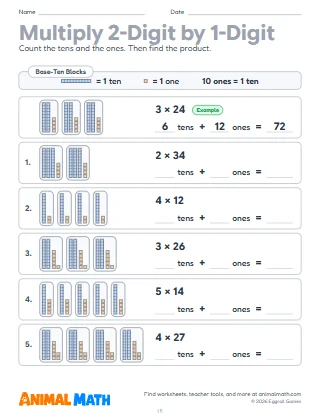
Five pages on why the area of a split rectangle is the distributive property. On page 1 each rectangle is drawn in unit squares and a line splits it in two: students write the area inside each part, then fill in the equation in three steps (5 × 8 = 5 × (5 + 3) = 5 × 5 + 5 × 3 = 25 + 15 = 40); one rectangle is split across its rows. Page 2 leaves out the squares: students split a 2-digit number into tens and ones on top of the model (6 × 14 = 6 × (10 + 4)), and on the last two a 3-digit number into hundreds, tens and ones, three parts to add. Page 3 has area models with numbers missing: a side length to find from an area, the side both parts share, a part's area from the total, a part from the whole side, and one with two missing. Page 4 has ten equations with one number missing, such as 8 × (10 + □) = 80 + 56, then three rectangles to match to the one equation that shows them. Page 5 splits both numbers into tens and ones, so 12 × 14 is four parts, and ends with two rectangles to split any way that makes the work easier (the key shows one way). Every page starts with a worked example.
Draw a 6 by 14 rectangle on grid paper and count the squares together; it takes a while. Then draw a line after 10 columns and ask what two facts the class sees now. Write 6 × 14 = 6 × (10 + 4) = 60 + 24 under it and point to each number in the picture. On page 5, compare students' own splits: 7 × (10 + 6) and 7 × (8 + 8) give the same area.
Look for rectangles at home: a sheet of stickers, a tiled floor, a muffin tin. Ask your child to cover part of it with a hand and say the two facts they see, then add them. Bigger rectangles work too: a 4 by 23 patio is 4 by 20 and 4 by 3.
This pack supports the following Common Core State Standards for Mathematics:
© Copyright 2010. National Governors Association Center for Best Practices and Council of Chief State School Officers. All rights reserved.
How the area of a rectangle shows the distributive property: a rectangle split into parts has the same area as its parts added, so 6 × 14 = 6 × (10 + 4) = 60 + 24. Students find the area of each part of split rectangles, write the equations, find missing side lengths and areas, and split rectangles of their own.
Tell us what to make next, or build your own with a worksheet maker.
This worksheet is free to download, print, copy, and hand out in your classroom or at home. You do not need to create an account, and there are no watermarks on the PDF.