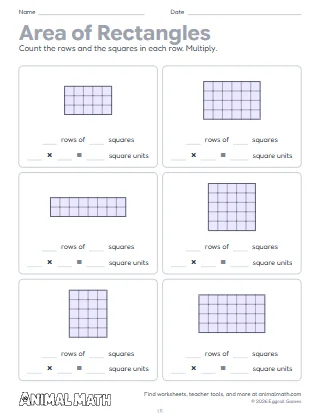
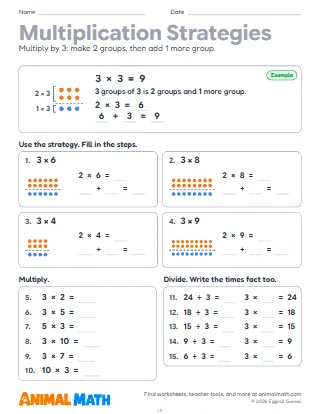
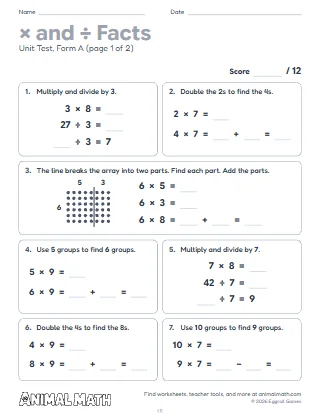
Five pages on breaking a fact apart into two facts you know and adding them, the distributive property. On page 1 a line already splits each array: write the fact for each part and add (9 × 8 = 9 × 5 + 9 × 3 = 45 + 27 = 72); two of the arrays are split by rows. On page 2 students draw the line themselves to make the 5s or 2s fact each array asks for. Page 3 splits rectangles with their side lengths: write the area of each part inside it and add, and on the last two find the missing side length first. Page 4 has 12 break-apart equations with one number missing (9 × 6 = 7 × 6 + __ × 6), then four facts where students circle the one break apart that matches. Page 5 has four stories that break a fact apart (9 rows of 7 carrots counted as 9 rows of 4 and 9 rows of 3) and two "Who is right?" problems with two ways to break a fact apart.
Build an array with counters or draw one on grid paper and lay a pencil across it to split it. Ask what two facts the class sees, and whether the total changed. Then move the pencil: a different split, the same total. Page 2 makes a good talk: why might a 5s fact be easier to start from?
Break apart facts out loud: 7 × 6 is 7 × 3 and 7 × 3, 21 and 21, 42. Use a muffin tin, an egg carton or a sheet of stickers and cover part of it with a hand to see the two facts.
This pack supports the following Common Core State Standards for Mathematics:
© Copyright 2010. National Governors Association Center for Best Practices and Council of Chief State School Officers. All rights reserved.
The distributive property: breaking a hard fact apart into two facts you know, like 9 × 8 = 9 × 5 + 9 × 3. Students split arrays and rectangles, write the two facts and add, find missing numbers, solve stories and decide who broke a fact apart the right way.
Tell us what to make next, or build your own with a worksheet maker.
This worksheet is free to download, print, copy, and hand out in your classroom or at home. You do not need to create an account, and there are no watermarks on the PDF.