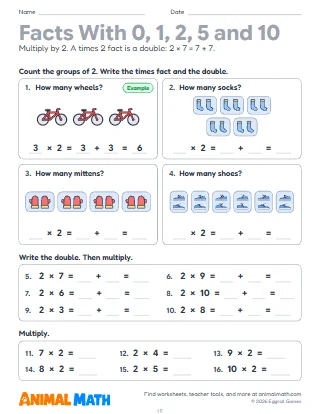
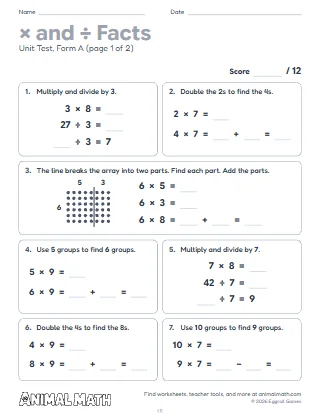
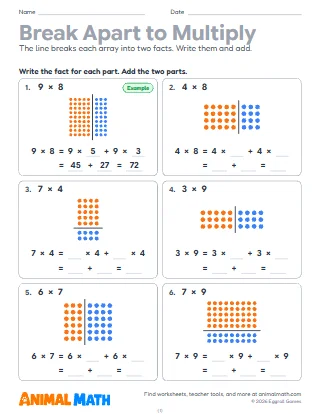
Six pages, one a fact family, each built the same way. At the top a worked example shows the fact as an array split into facts students already know, with the steps written out: 3 × 3 is 2 × 3 = 6, then 6 + 3 = 9. Under it are four arrays to do the same way by filling in the steps, then six facts from the family to multiply and six division facts, each written with the times fact that goes with it (24 ÷ 3 = 8 and 3 × 8 = 24). Page 1 is the 3s (2 groups and 1 more group), page 2 the 4s (double the 2s), page 3 the 6s (5 groups and 1 more group), page 4 the 7s (5 groups and 2 groups), page 5 the 8s (double the 4s) and page 6 the 9s (10 groups take away 1 group), where counting by 9s shows the pattern in the digits.
Build the example array with counters or on grid paper and cover part of it with a sheet of paper: what fact do you see now? Then uncover the rest. Take one family a day, as the lessons do, and keep the sheets in a folder so students can look back at the strategy for a fact they forget.
Ask for a fact, then ask how your child worked it out: 6 × 3 is 5 × 3 = 15 and 3 more, 18. Draw dots in rows on scrap paper and split them with a line, or use rows of coins or cereal.
This pack supports the following Common Core State Standards for Mathematics:
© Copyright 2010. National Governors Association Center for Best Practices and Council of Chief State School Officers. All rights reserved.
The 3s, 4s, 6s, 7s, 8s and 9s facts, one family at a time, each with a strategy that starts from a fact students already know. Students follow a worked example on an array, fill in the strategy steps on four more arrays, practice the facts and divide by thinking of the times fact.
Tell us what to make next, or build your own with a worksheet maker.
This worksheet is free to download, print, copy, and hand out in your classroom or at home. You do not need to create an account, and there are no watermarks on the PDF.