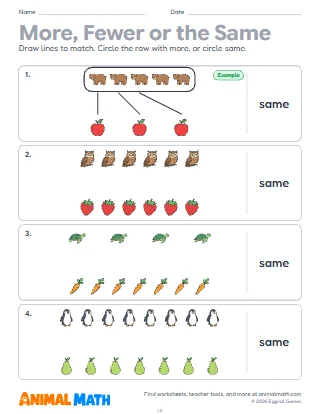
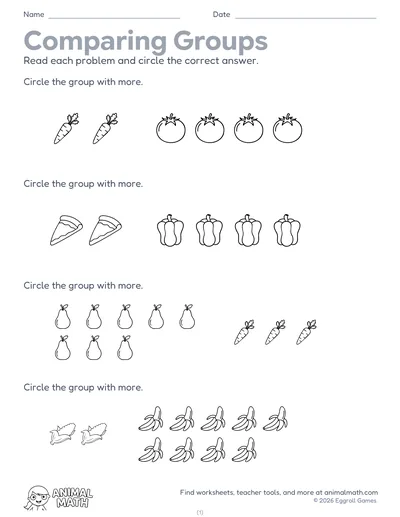
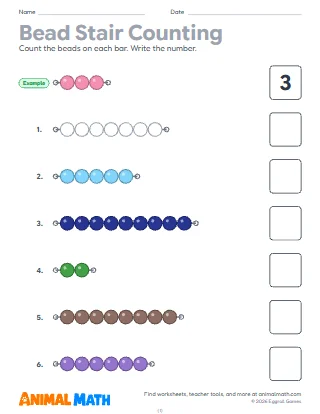
Five pages of one-to-one matching, the groundwork for counting and comparing. On page 1 students give each animal one snack, drawing a line from each animal to one food; the first problem is done as an example. Page 2 matches cars to parking spaces, rockets to planets and frogs to lily pads, then asks: are there enough? Students circle yes or no. Page 3 has them draw one cookie on each plate, one ball in each box, one straw in each cup and one scoop on each cone, then count the plates and the cookies and write both numbers. Page 4 matches two rows and circles the row that has some left over. On page 5 students draw one egg in each nest, in rows on branches and scattered, and write how many eggs they need.
Start with real things: set out cups and give each child one straw, or put one bear on each plate. Ask "Is there one for each? Are there any left over?" before turning to the page. Read each question aloud, and have students touch a picture, then its partner, before drawing the line. On page 3, point out that the two numbers are the same: one for each makes the same number.
Set the table together: one plate, one cup and one spoon for each person. Ask whether there are enough chairs for everyone, or enough socks for the feet in the family, and match them to check.
This pack supports the following Common Core State Standards for Mathematics:
© Copyright 2010. National Governors Association Center for Best Practices and Council of Chief State School Officers. All rights reserved.
Matching one thing to each thing, the first step toward counting and comparing groups. Students draw lines to pair animals with snacks and cars with parking spaces, decide whether there are enough, draw one in each and find the group with some left over.
Tell us what to make next, or build your own with a worksheet maker.
This worksheet is free to download, print, copy, and hand out in your classroom or at home. You do not need to create an account, and there are no watermarks on the PDF.