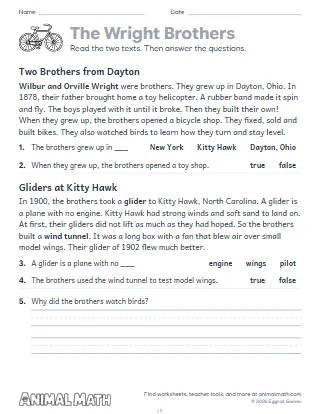
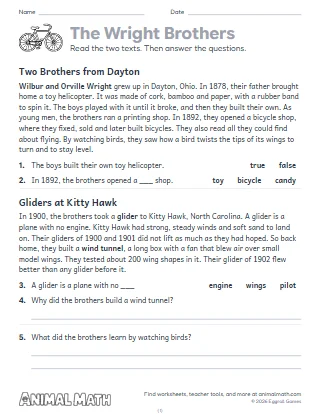
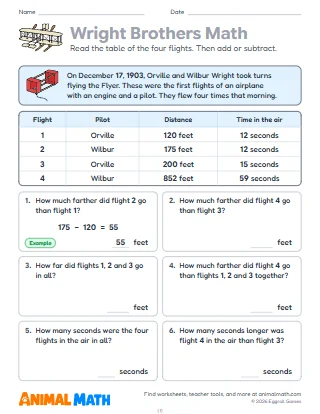
Wilbur and Orville Wright, whose first flights on December 17, 1903 we remember on Wright Brothers Day, learned to fly by testing: they changed one thing at a time on their gliders and model wings and watched what happened. A paper airplane is a way to try the same. This pack folds the classic dart, then asks children to tell how to fly it, test it and draw and write about flying.
Six pages on handwriting lines. Page 1 shows how to fold a paper airplane in six steps, each fold pictured: a dashed line where to fold and an arrow for which way. Page 2 has the same six steps mixed up, to number in order. Page 3 is a how-to in four steps to draw and write, page 4 a test-flight log, page 5 a story in three parts and page 6 a page to draw and write where you would go if you could fly.
Fold the planes together from page 1, a step at a time, then let students number page 2 from memory. For page 4, mark a starting line and count steps (or use a tape measure); each student changes just one thing between flights, such as the wing folds or how hard they throw.
Fold two planes, change one thing on the second one, and race them across a room. Which flew farther? Why do you think so?
A paper airplane to fold, with every fold pictured, and writing about flight for Wright Brothers Day. Students follow the steps and put them back in order, write a how-to of their own, test their plane and log each flight, then write a story and tell where they would go if they could fly.
Tell us what to make next, or build your own with a worksheet maker.
This worksheet is free to download, print, copy, and hand out in your classroom or at home. You do not need to create an account, and there are no watermarks on the PDF.