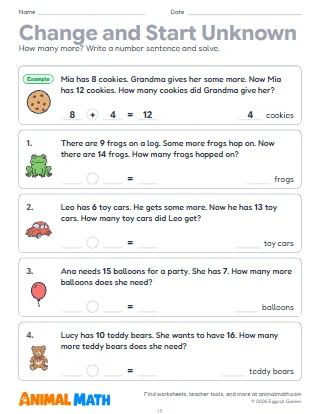
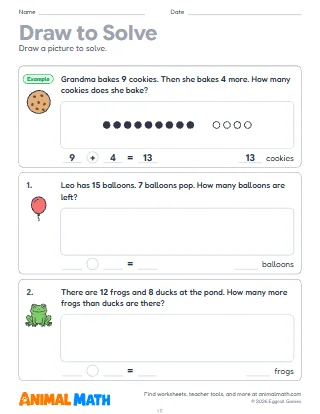
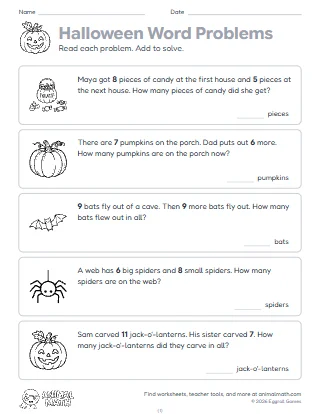
Five pages of part-part-whole stories within 20: two parts make a whole, and the question asks for the whole or for one part. Page 1 puts two parts together: 9 frogs on a log and 8 in the water. Page 2 takes a whole apart: 15 fish, 9 are orange, how many are yellow? Page 3 has a number bond beside each story; students write the whole in the top circle and the parts below, then write a number sentence. On page 4 the story gives only the whole, so students find three different ways to split it, such as 8 balloons as 2 and 6, 3 and 5, or 4 and 4. Page 5 shows a bar model for each story, with a question mark where the unknown goes. Each page starts with a worked example.
Model part-part-whole with two-color counters before page 1: show 7 red and 6 yellow, push them together, and talk about the parts and the whole. On page 4, collect every way the class found for 12 toy cars and put them in order (0 and 12, 1 and 11, 2 and 10 ...) to see the pattern.
Sort a handful of things into two kinds, like spoons and forks, and ask how many in all, then how many forks if you know the total and the spoons. Draw a number bond on scrap paper together and fill it in.
This pack supports the following Common Core State Standards for Mathematics:
© Copyright 2010. National Governors Association Center for Best Practices and Council of Chief State School Officers. All rights reserved.
A 5-page part-part-whole word problems pack for 1st grade, with numbers within 20. Put two parts together to find the whole (7 red apples and 6 green apples), take a whole apart to find the missing part (12 balloons, 5 are red, how many are blue?), and fill in a number bond for each story. Then find three different ways to split a total, and use bar models to solve. Every page comes in color and in black and white. Answer keys included.
Tell us what to make next, or build your own with a worksheet maker.
This worksheet is free to download, print, copy, and hand out in your classroom or at home. You do not need to create an account, and there are no watermarks on the PDF.