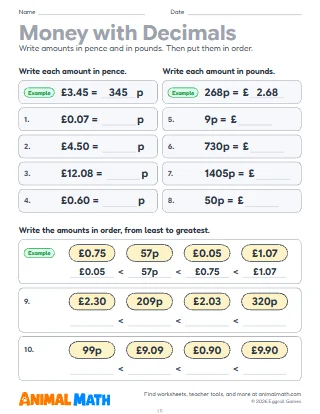
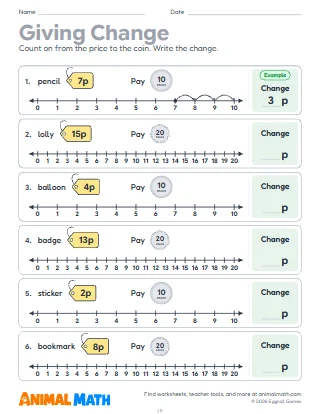
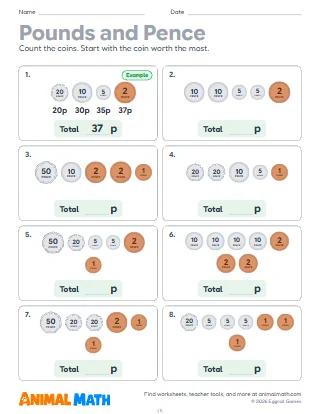
Five pages of money stories, Year 3 first, then Year 4. Pages 1 to 3 write pounds and pence apart, as Year 3 records them: £3 and 45p. Page 1 adds two or three prices, and some totals cross a pound, so 75p and 45p make £1 and 20p. Page 2 subtracts: the change from a £2 coin or a £5 note, what is left after shopping, how much more is needed and the difference between two prices. Page 3 asks which of two things costs more and by how much, then children number four prices from least to greatest, such as 90p, £1, £1 and 9p and £1 and 90p. Page 4 moves to decimal notation: children write amounts in pence as pounds and pounds as pence (345p = £3.45, £0.60 = 60p, 8p = £0.08), then solve stories written with prices like £4.65. On page 5 they round each price to the nearest pound, estimate the total, find the exact total and say whether it is more or less than the estimate. Each story has its answer line with its unit and room to work, and the first problem on each page is worked as an example.
Set up a class shop with price labels and play coins and notes. Before page 2, buy something for 65p with a £2 coin and count up to find the change: 65p to 70p, then to £1, then to £2. For page 4, show that 345p and £3.45 are the same amount: three pounds and forty-five pence. Before page 5, ask the class to estimate a shopping total aloud, then check it on paper.
At the shops, ask your child to estimate the total of two or three things by rounding each price to the nearest pound, then check it on the receipt. Give them a few coins and ask how much change they would get from a £5 note for a comic or a snack. Ask which of two prices is more, and by how much.
This pack supports the following Common Core State Standards for Mathematics:
© Copyright 2010. National Governors Association Center for Best Practices and Council of Chief State School Officers. All rights reserved.
Money stories in pounds and pence, from buying a comic or a cinema ticket to getting change from a £5 note. Students add and subtract amounts, compare prices, write money with a decimal point and estimate a total before working it out.
Tell us what to make next, or build your own with a worksheet maker.
This worksheet is free to download, print, copy, and hand out in your classroom or at home. You do not need to create an account, and there are no watermarks on the PDF.