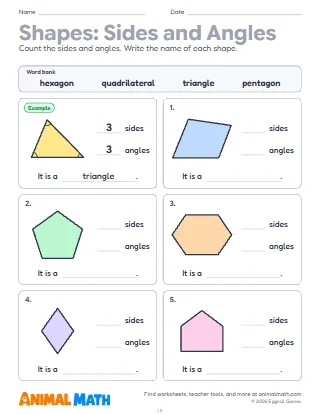
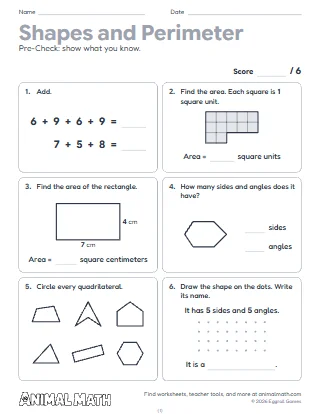
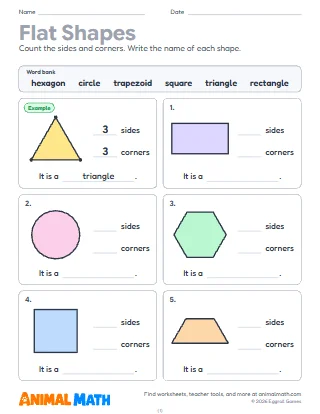
Five pages on quadrilaterals and the groups they belong to. On page 1 students circle the quadrilaterals in a row of shapes (a curved side, an open corner, or 3 or 5 sides rule a shape out; a shape with a corner that points in still counts), then count the right angles and the pairs of parallel sides of six quadrilaterals and say whether all 4 sides are equal. Tick marks show sides of the same length and a small square shows a right angle. Page 2 has a list of names in order, from square down to quadrilateral: students write the first name that fits each of nine shapes, some of them turned. Page 3 sorts ten shapes in a Venn diagram of rectangles and rhombuses, with the squares in both circles and the others outside, then asks which shapes are rectangles and which are rhombuses. On page 4 students draw quadrilaterals on dot paper from clues and name them, including ones that are not rectangles, rhombuses or squares. Page 5 is shape riddles and yes-or-no questions such as "Is every rectangle a square?"
Before page 1, give each student an index card: its corner is a right angle tester. Have them check the corners of a book, a window and a tilted square drawn on the board. Before page 3, cut out a square and ask: does it have 4 right angles? Then it is a rectangle. Does it have 4 equal sides? Then it is a rhombus too. On page 4, compare drawings: two students can draw very different shapes for the same clue and both be right.
Go on a shape hunt for quadrilaterals: windows, books, tiles, a kite, a slice of cake. For each one, ask how many right angles it has and whether its sides are all the same length, then give it its best name. Turn a square cracker on its corner and ask if it is still a square.
This pack supports the following Common Core State Standards for Mathematics:
© Copyright 2010. National Governors Association Center for Best Practices and Council of Chief State School Officers. All rights reserved.
Quadrilaterals sorted by their sides and angles: squares, rectangles, rhombuses, parallelograms, trapezoids and the ones that fit none of these groups. Students count right angles and parallel sides, name and sort shapes, draw them on dot paper from clues and solve riddles.
Tell us what to make next, or build your own with a worksheet maker.
This worksheet is free to download, print, copy, and hand out in your classroom or at home. You do not need to create an account, and there are no watermarks on the PDF.