Loading preview...

Features

  • Dice and dot cards from 1 to 6: circle how many
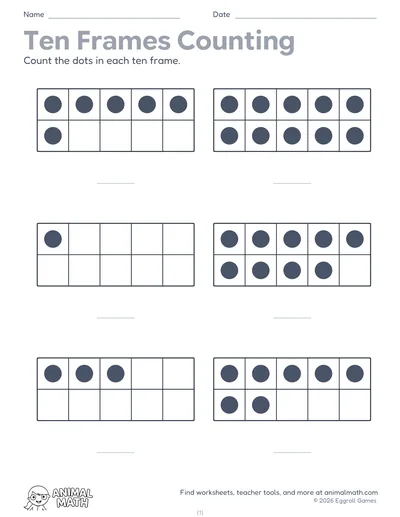
  • Five frames and ten frames: write how many
  • Match the same amount shown two ways, dice to five frames and ten frames to dominoes
  • Dominoes: how many on each side and how many in all, up to 10
  • Twelve quick-look cards from 1 to 10 to cut out for a flash game
  • Every page in color and in black and white
  • Answer keys included

Skills Covered

  • See small amounts without counting
  • Know a dot pattern on a die or card
  • Read five frames and ten frames at a glance
  • Match the same amount shown two ways
  • Put two small amounts together
  • See 6 to 10 as 5 and some more

How to Use This Pack

Five pages of quick looks. Page 1 has dice and dot cards from 1 to 6, some in a die pattern and some in a ring, a triangle or scattered: children circle how many from three numbers. On page 2 they write how many dots are in five frames and ten frames. Page 3 matches the same amount shown two ways: dice to five frames, then ten frames to dominoes. On page 4 children count each side of a domino and write how many in all. Page 5 is twelve dot cards from 1 to 10 to cut out for a flash game.

In the Classroom

Play the flash game with the cards on page 5: hold up a card for two or three seconds, hide it, and ask "How many did you see? How did you see it?" Children who say "I saw 3 and 3" are seeing groups, which is the goal. Start with the cards to 5, then add the bigger ones. Use the worksheets the same way: cover each picture with a hand, lift it for a moment, and let children answer from what they saw before they count to check.

At Home

Roll a die and call out the number before anyone counts the dots. Look for dot patterns around the house, on dominoes, buttons and game boards, and ask how many at a glance.

Tips for Success

  • Look first, then count to check
  • Ask how a child saw it: "3 and 2" means they saw the parts
  • Five frames and ten frames show 5 at once: 7 is 5 and 2 more
  • Keep the flash short, two or three seconds, so children look instead of count
  • Start the card game with 1 to 5 and add the bigger cards later

Common Core Standards Alignment

This pack supports the following Common Core State Standards for Mathematics:

  • K.CC.B.4a Count objects by saying numbers in order and matching exactly one number to each object, none skipped or counted twice.
  • K.CC.B.4b Know the final number in a count gives the total, and the total stays the same however the objects are arranged or counted.
  • K.CC.B.5 Tell how many: up to 20 objects in a line, array or circle, or 10 scattered. Also count out a requested number up to 20.
  • K.OA.A.1 Show adding and taking away in many ways: fingers, objects, pictures, sounds, acting out, words, or number sentences.

© Copyright 2010. National Governors Association Center for Best Practices and Council of Chief State School Officers. All rights reserved.

Quick Looks: Dot Patterns to 10

Pre-K – K

Seeing how many dots there are at a glance, without counting one by one, on dice, dot cards, five frames, ten frames and dominoes. Children circle or write how many, match the same amount shown two ways, add the two sides of a domino and play a quick-look flash game with cards to cut out.

Download PDF
Pin

What’s Included

  • 5 worksheets in color and in black and white, with answer keys for the first four (14 pages)
  • Dice and dot cards to circle, and five and ten frames to write
  • Matching and dominoes
  • Twelve quick-look cards to cut out
Can’t find what you need?

Tell us what to make next, or build your own with a worksheet maker.

Suggest a worksheet

Free to print and share

This worksheet is free to download, print, copy, and hand out in your classroom or at home. You do not need to create an account, and there are no watermarks on the PDF.