Remembrance Day, on 11 November, began as Armistice Day: the First World War ended at 11 o'clock on 11 November 1918, the eleventh hour of the eleventh day of the eleventh month. In the UK, Canada, Australia and New Zealand many people wear a red poppy and keep two minutes' silence at 11 o'clock to remember those who have died in wars. These pages keep to clocks, the calendar and poppies, so they suit a quiet, thoughtful lesson.
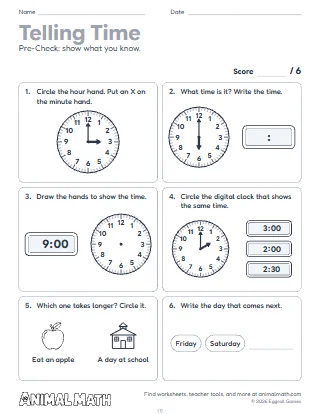
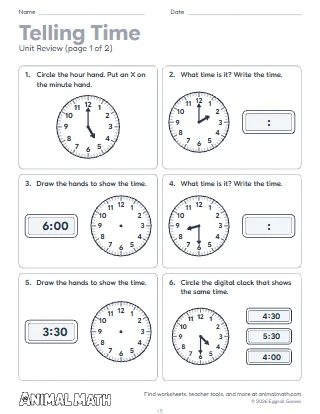
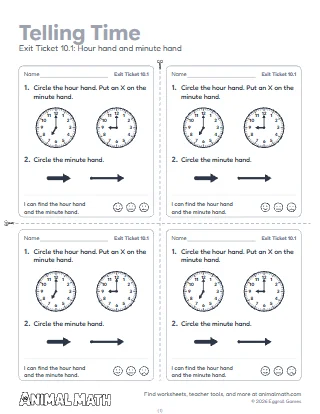
Five pages of time and calendar practice. Page 1 starts with a note about the two minutes' silence, then has eight o'clock times to read; children write the hour, and the first, 11 o'clock, is done as an example. Page 2 has eight clocks at o'clock or half past, each with two names: children look at both hands and circle the right one. Page 3 writes quarter past, half past and quarter to times in words, with the words in a bank at the top. Page 4 asks children to draw both hands for twelve times in words. Page 5 is a November calendar: circle 11 November and find its day of the week, the second Sunday, the number of Sundays, the date a week later, November's number in the year, and how many seconds are in the two minutes' silence.
Show a real clock at 11 o'clock and talk about why people stop and stay quiet at that time on 11 November. Pages 1 and 2 suit Year 1 and Grade 1; pages 3 and 4 stretch older children to quarter hours. On page 5, find the first of the month together, then let children count on along the rows.
Look at a clock together at different times of the day and say the time in words: half past 4, quarter to 6. On 11 November, watch the clock with your child as 11 o'clock comes round, and talk about the poppies they may see people wearing.
This pack supports the following Common Core State Standards for Mathematics:
© Copyright 2010. National Governors Association Center for Best Practices and Council of Chief State School Officers. All rights reserved.
Telling the time and reading a calendar for Remembrance Day, when many people keep two minutes' silence at 11 o'clock on 11 November. Children read o'clock, half past, quarter past and quarter to, draw the hands, and answer questions about November on the calendar.
Tell us what to make next, or build your own with a worksheet maker.
This worksheet is free to download, print, copy, and hand out in your classroom or at home. You do not need to create an account, and there are no watermarks on the PDF.