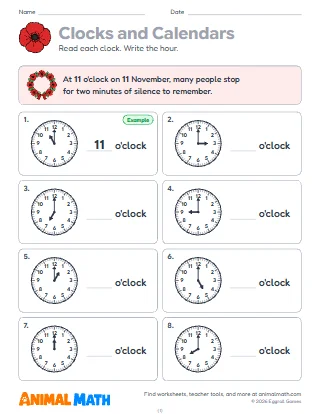
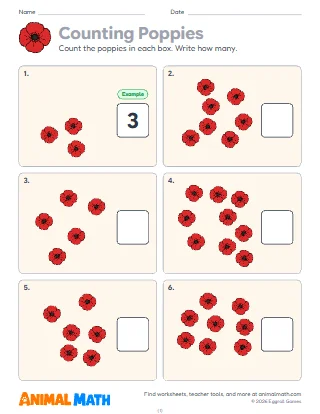
Remembrance Day, on 11 November, marks the end of the fighting in the First World War at 11 o'clock on 11 November 1918. People wear red poppies, lay wreaths and keep a silence at 11 o'clock to remember those who have died in wars: two minutes in the UK and Canada, one minute in Australia, and in New Zealand, where it is often called Armistice Day, a silence too. These pages tell that story gently, through poppies, a poem and the silence.
Eight pages for the week of Remembrance Day. Page 1 explains why we wear a poppy, with four questions. Page 2 is the poem "In Flanders Fields" by John McCrae, its lines numbered, to read aloud together; page 3 asks about its rhymes, its verses and who is speaking. Page 4 tells the story of the eleventh hour, the first Armistice Day silence and the Cenotaph. Page 5 is a timeline from 1913 to 1922: children write the year of each event from the box of years, then work out the years between. Page 6 matches words to their meanings. Page 7 is the poem's first verse to copy, and page 8 an acrostic poem for PEACE.
Read page 1 together before Remembrance Day, then read the poem aloud on page 2, perhaps more than once, before children answer page 3. Keep the timeline for a maths link: counting on from one year to another. If your school keeps the silence at 11 o'clock, talk about it beforehand with page 4.
Read the poem together and talk about why people wear poppies. If there is a war memorial near you, visit it and look at the wreaths.
Why we wear a poppy, the poem "In Flanders Fields" and the silence at the eleventh hour. Children read short texts and the poem, answer questions, read a timeline, match words to their meanings and write a poem for peace.
Tell us what to make next, or build your own with a worksheet maker.
This worksheet is free to download, print, copy, and hand out in your classroom or at home. You do not need to create an account, and there are no watermarks on the PDF.