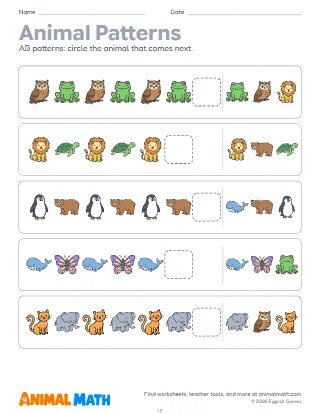
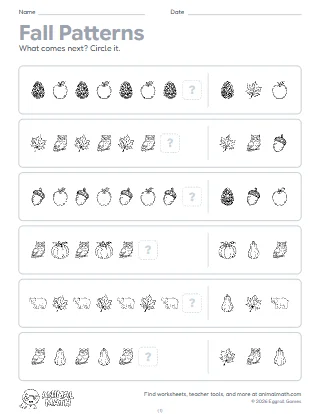
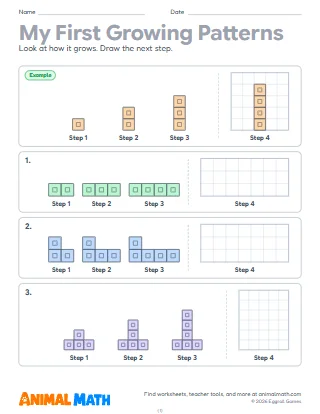
Five pages that take repeating patterns past "what comes next". Page 1 shows rows of animals: children circle the core, the part that repeats, and write it with letters (owl, owl, frog is A A B). Page 2 is shape patterns to continue: draw the next three shapes. Page 3 shows a row of animals and three rows of shapes; children circle the shapes that make the same pattern, which means looking at the letters rather than the pictures. Page 4 has one animal out of place in each row: circle it and pick the one that belongs. Page 5 continues number and letter patterns, then asks children to make an AB and an ABC pattern of their own. Each page starts with a worked example.
Build patterns with children first: stand in a line as sit, stand, stand, sit, stand, stand and ask the class to name it with letters. Show that the same AAB pattern can be clap, clap, stomp or red, red, blue. Ask for the core before asking what comes next: finding the core is the skill that makes the next one easy.
Look for patterns around you: tiles, fences, socks, and songs with repeating parts. Make patterns with spoons and forks or blocks, then ask your child to read the pattern with letters and continue it.
This pack supports the following Common Core State Standards for Mathematics:
© Copyright 2010. National Governors Association Center for Best Practices and Council of Chief State School Officers. All rights reserved.
A 5-page 1st grade pack on repeating patterns. Circle the part of a pattern that repeats (the core) and name it with letters: AB, AAB, ABB, ABC, AABB, ABBB and ABCD. Draw the next three shapes to keep a pattern going. Find the row of shapes that makes the same pattern as a row of animals. Circle the animal that breaks a pattern and choose the one that belongs. Last, continue number and letter patterns and make patterns of your own. Every page comes in color and in black and white. Answer keys included.
Tell us what to make next, or build your own with a worksheet maker.
This worksheet is free to download, print, copy, and hand out in your classroom or at home. You do not need to create an account, and there are no watermarks on the PDF.