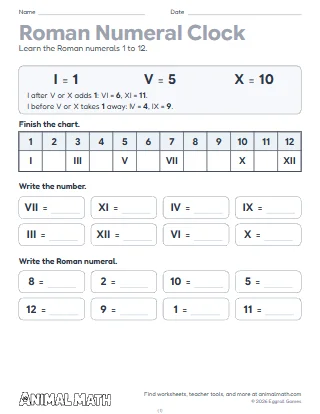
Five pages on Roman numerals, from Year 4 numerals to 100 up to Year 5 numerals to 1,000 and years. Page 1 starts with a key of the seven letters and the six subtracting pairs, then changes numbers to 100 both ways. Page 2 breaks numerals to 1,000 into hundreds, tens and ones (CDXLVII = 400 + 40 + 7 = 447), then reads numerals with no tens or no ones. Page 3 writes numbers to 1,000 as Roman numerals, with a worked example step by step. Page 4 reads years on foundation stones, a clock tower and the end of films, then writes years in Roman numerals. Page 5 finds the mistakes (49 is XLIX, not IL), compares numerals with <, > and =, and puts numerals in order.
Write the seven letters on the board with their values and ask what happens when a smaller letter comes before a larger one. Build 447 together a place at a time: 400 is CD, 40 is XL, 7 is VII. Page 5 is a good one to talk through: why is 49 written XLIX and not IL?
Look for Roman numerals together: on clock faces, foundation stones, the end of film credits, the chapters of a book or a monarch's name. Ask your child to read the number, or to write the year they were born in Roman numerals.
This pack supports the following Common Core State Standards for Mathematics:
© Copyright 2010. National Governors Association Center for Best Practices and Council of Chief State School Officers. All rights reserved.
Reading and writing Roman numerals up to 1,000 (M), including years written in Roman numerals. Students use a key of I, V, X, L, C, D and M, change numbers both ways, break numerals into hundreds, tens and ones, read years on stones and film credits and find the mistakes.
Tell us what to make next, or build your own with a worksheet maker.
This worksheet is free to download, print, copy, and hand out in your classroom or at home. You do not need to create an account, and there are no watermarks on the PDF.